W2P Software: What Print Brands Need in 2026
Print brands entering 2026 are not asking whether digital transformation matters anymore. They are asking a sharper question: what kind of W2P software actually helps us grow, convert faster, and modernize the buying experience without adding operational complexity?
That question matters to small studios, photographers, emerging print-on-demand brands, mid-size regional printers, and established photo book companies alike. Traditional web-to-print stacks often create too much friction: too many design steps, too much manual intervention, too many abandoned carts, and too little differentiation. Buyers want speed, simplicity, mobile access, realistic previews, and confidence before they order. Operators want automation, scalability, white-label control, and less overhead.
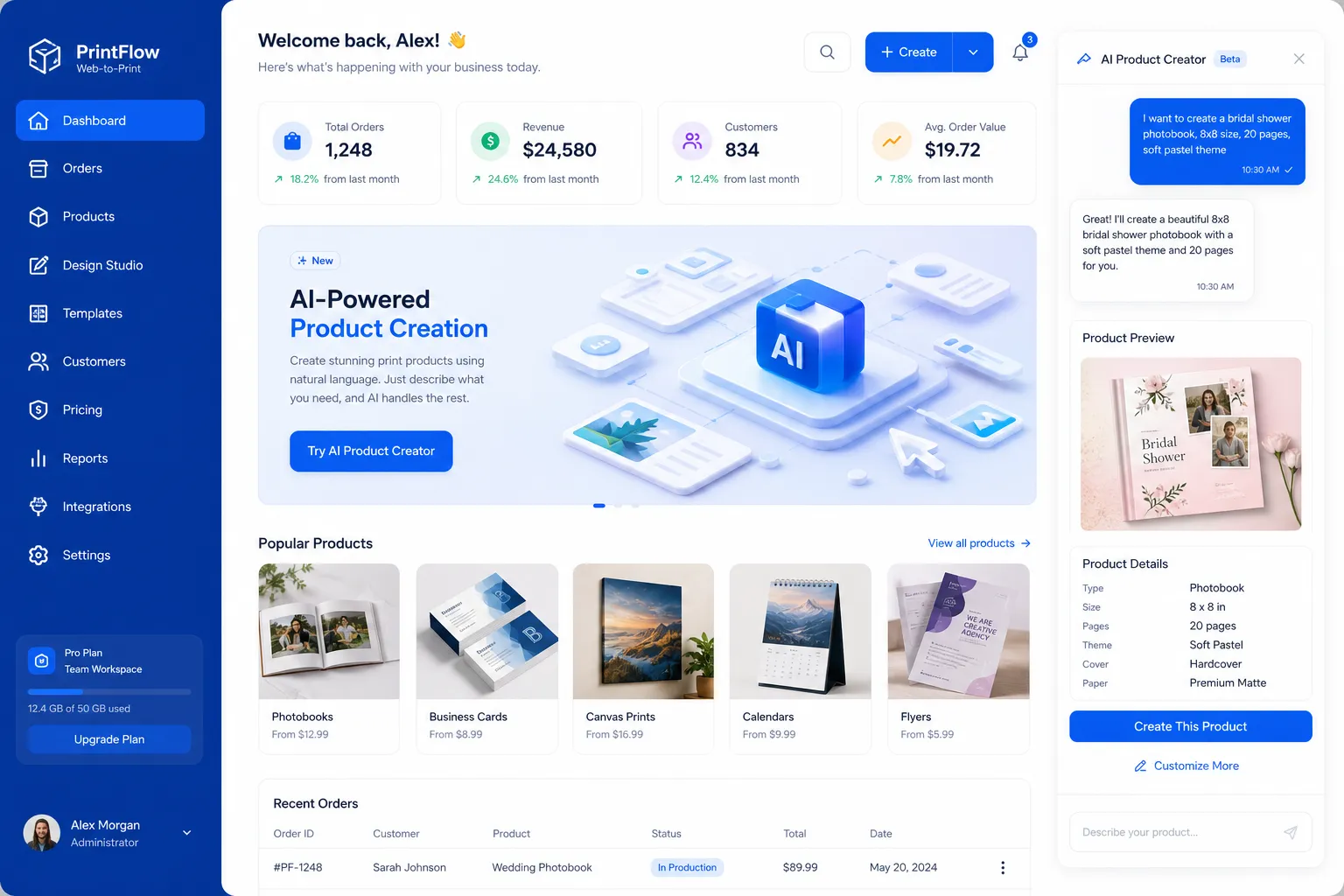
In 2026, future-ready print commerce is moving beyond static product configurators and clunky editors. The next wave is AI-powered, conversational, mobile-first, and deeply integrated into the storefronts customers already use. That is where Media Rex Alliance represents a meaningful shift: a white-label AI print platform that turns natural language prompts into print-ready products, supports photo uploads, delivers photorealistic 3D and AR previews, and automates fulfillment through a premium global print network.
Why W2P Software Matters More in 2026 Than It Did in 2023
Three years ago, many print businesses could still compete with a decent storefront, a basic uploader, and a manual production workflow behind the scenes. That window is closing fast.
Customers now expect the kind of experience they get from modern ecommerce: instant response, guided creation, transparent pricing, mobile usability, and visual reassurance before purchase. The legacy pattern of “upload file, wait for proof, exchange emails, then approve” increasingly feels outdated.
At the same time, print businesses face margin pressure from rising acquisition costs, labor constraints, and customer expectations for shorter turnaround times. In that environment, the right platform is not just a storefront layer. It is a conversion engine, an automation layer, and a scalable operating system.
"In the web-to-print software segment, the market was valued at USD 1.43 billion in 2025 and is projected to grow from USD 1.56 billion in 2026 to USD 3.13 billion by 2034, exhibiting a CAGR of 9.11% during the forecast period." - Fortune Business Insights
That growth is not happening because print businesses want more software. It is happening because they need more efficient ways to sell, personalize, produce, and fulfill.
What W2P Software Actually Means in 2026
At a basic level, W2P software lets customers customize and order printed products online. But in 2026, that definition is too narrow.
Modern web-to-print platforms should combine:
storefront integration
product personalization
pricing logic
proofing and previews
print-ready output generation
workflow automation
fulfillment orchestration
analytics and scalability
The biggest change is how creation happens.
Older systems assume the customer wants to manipulate templates manually using traditional design tools. Newer systems recognize that many customers do not want to “design” at all. They want to describe what they want, upload a few photos, choose a format, and move forward confidently.
That is where conversational AI becomes transformative. Instead of requiring design fluency, it allows customers to create premium products through natural language. For photo books, wall art, cards, calendars, and personalized merchandise, this can dramatically reduce friction and accelerate purchase decisions.
The Core Problem Most Legacy W2P Platforms Still Haven’t Solved
Competitor content tends to cover the usual checklist: storefronts, templates, VDP, pricing, workflow automation, and integrations. Useful, yes. But many gloss over the deepest problem in modern print ecommerce:
The customer journey is still too hard
Even when a platform is technically capable, the buying experience often remains cumbersome:
too many steps to create a product
too much reliance on template editing
poor mobile usability
weak previews
no emotional “wow” moment
no continuity across devices
too much operator intervention after checkout
For photo-centric and personalized products, complexity kills conversion. Customers do not want to become designers. They want a result.
This is one of the biggest content gaps in most discussions about W2P software. The real differentiator in 2026 is not only what the software can produce. It is how effortlessly it gets the customer from intent to order.
What Print Brands Should Prioritize in W2P Software in 2026
1. Conversational Product Creation

The most forward-looking platforms reduce dependence on manual editing and enable customers to create products with natural language prompts.
That means a user can describe a desired style, mood, occasion, theme, or layout preference and let the system generate a polished product structure automatically. Instead of dragging elements around a canvas, they can say what they want and refine from there.
For brands serving consumers, creators, photographers, and gift buyers, this removes a major source of friction. For enterprise print businesses, it opens up faster onboarding for end customers who need branded personalization without training.
Why it matters:
lowers abandonment during creation
makes personalized products accessible to non-designers
speeds up decision-making
reduces support load
increases conversion on mobile
Media Rex Alliance is built around this exact shift. Its autonomous creation engine turns prompts into ready-to-print products, helping brands offer a radically simpler creation flow than conventional editors.
2. Print-Ready Output Without Manual Cleanup
A modern platform should not stop at visualization. It should generate production-ready files that align with actual print requirements.
That means:
correct sizing
bleed and trim awareness
layout consistency
smart image placement
production-safe export workflows
If AI helps create the product but human teams still need to rebuild or fix files before production, the efficiency gain is incomplete. The best systems compress the gap between idea and output.
For scaling businesses, this matters because every manual touch introduces cost, delay, and inconsistency.
3. White-Label Integration Into Existing Storefronts or Apps
A future-ready W2P system should not force a brand to rebuild its customer experience from scratch.
The ideal setup is white-label and embeddable, allowing businesses to integrate advanced product creation into their current storefront, domain, or app while preserving brand identity.
This is especially valuable for:
established photo book brands modernizing legacy flows
print-on-demand startups launching quickly
regional print players enhancing ecommerce without a full replatform
studios and photographers offering branded product creation
enterprise print businesses wanting full visual and domain control
Media Rex Alliance is designed for exactly this deployment model. It can be fully branded to the client’s identity, domain, and visual system, allowing businesses to offer AI-powered print creation as their own experience.
4. Photorealistic 3D and AR Previews
One of the most overlooked drivers of conversion in print ecommerce is customer confidence. People hesitate when they cannot fully imagine the final product.
That is why high-quality 3D and AR previews are becoming essential, not optional.
When buyers can view a photo book, framed print, card, or personalized product in a realistic way before purchase, they are more likely to proceed. This reduces uncertainty and makes premium pricing easier to justify.
Strong preview capabilities help with:
conversion improvement
cart completion
reduced buyer hesitation
fewer disappointment-driven support cases
stronger premium brand perception
Media Rex Alliance includes photorealistic 3D and immersive AR previews, allowing customers to validate their purchase visually before ordering.
5. Mobile-First, Browser-Based Experience
A surprising number of web-to-print experiences still feel like desktop software squeezed into a browser. That is no longer good enough.
By 2026, strong W2P software must be:
mobile-first
browser-based
fast-loading
touch-friendly
frictionless without app installs
This matters because many end users now begin personalized shopping journeys on mobile, even if they complete later on desktop. If the creation flow breaks on smaller screens, conversion suffers immediately.
Media Rex Alliance supports a browser-based, no-app-required experience that feels natural across devices, which is particularly valuable for consumer-facing print brands and mobile-heavy acquisition funnels.
6. Cross-Device Continuity
The modern buyer journey is fragmented across moments and screens. A customer may start on mobile, revisit on tablet, and complete on desktop. Or vice versa.
A future-proof platform should support local and cloud sync so projects persist seamlessly across devices. This improves usability and protects revenue that would otherwise be lost when sessions or drafts disappear.
This feature is especially important for:
longer-form products like photo books
family or event projects with multiple contributors
premium custom products requiring review before purchase
busy customers who create in short sessions
Cross-device continuity is one of those capabilities users rarely ask for directly but strongly feel when it is missing.
7. Automation From Order to Fulfillment
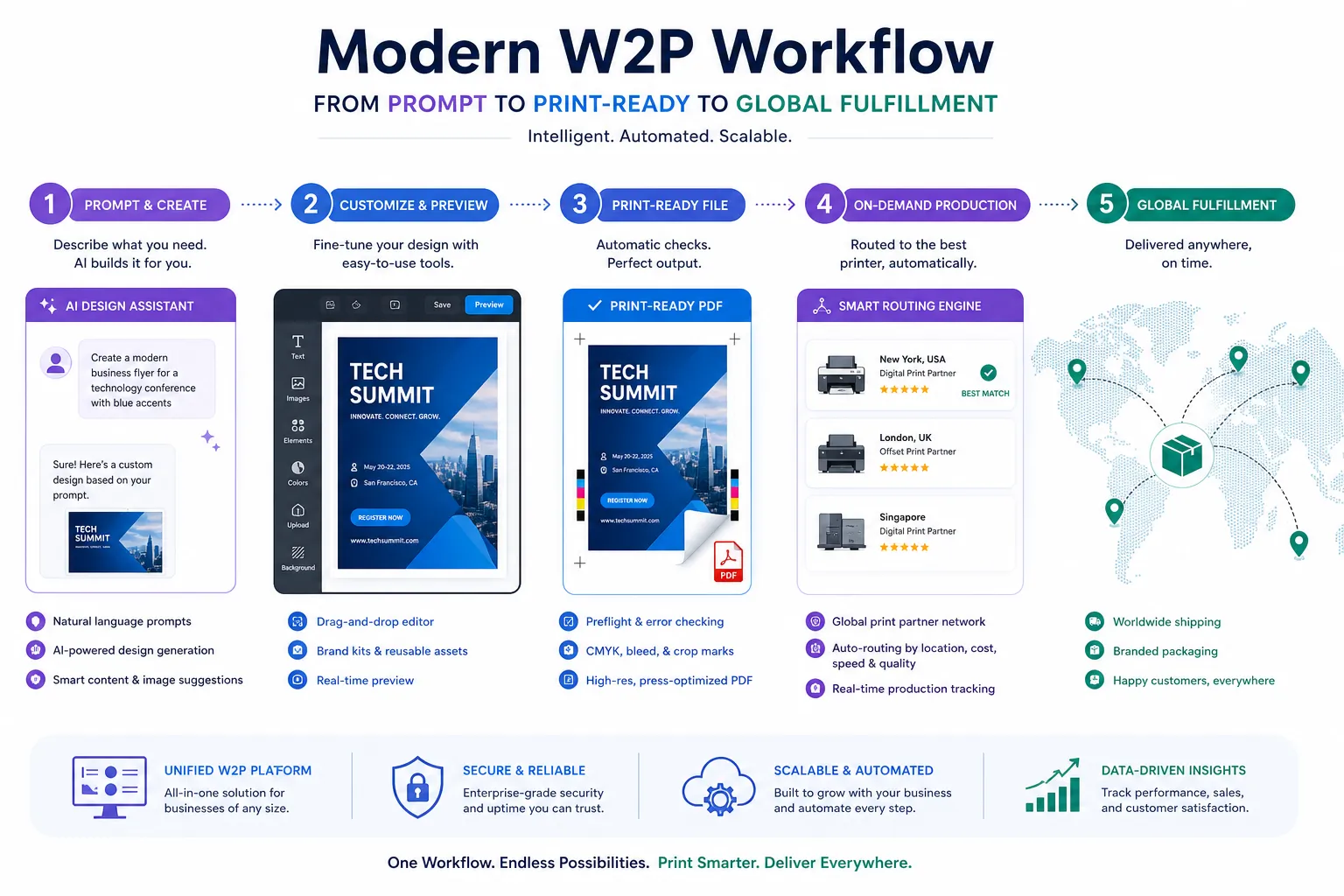
Modern W2P software should not end at checkout. It must automate the operational flow that follows.
That includes:
order capture
file preparation
routing
production coordination
fulfillment orchestration
shipment tracking
For brands that want a no-stock, low-overhead model, automated fulfillment is a strategic advantage. It reduces the need for inventory, simplifies scaling, and allows the business to focus more on customer acquisition and brand experience.
Media Rex Alliance supports on-demand production through an automated fulfillment pipeline and a global network of premium printers, making it especially attractive for brands that want to expand without building production infrastructure internally.
8. Scalability Across Business Models
Not every print business needs the same configuration, but every serious business needs room to grow.
The best platforms scale across use cases such as:
Business Type | What They Need Most |
|---|---|
Small studios | Fast launch, low overhead, easy branded selling |
Photographers | Premium presentation, visual confidence, mobile access |
New POD brands | Rapid deployment, no stock, automated fulfillment |
Mid-size print brands | Better conversion, workflow efficiency, brand control |
Regional print players | Storefront modernization, operational scale, differentiated UX |
Established photo book companies | Legacy modernization, AI-assisted creation, better previews, lower friction |
Media Rex Alliance is positioned well across this spectrum because it is not just a tool for uploading files. It is a scalable white-label SaaS layer built specifically for AI-driven print creation.
What Competitor Articles Commonly Cover - And What They Often Miss
Most top-ranking articles do a solid job on a few recurring themes:
Common strengths in competitor content
defining web-to-print clearly
explaining B2B and B2C use cases
highlighting automation and order management
mentioning design tools and VDP
discussing integrations and pricing logic
emphasizing scalability and implementation planning
Common gaps they leave behind
The stronger opportunity is in what they underemphasize:
They rarely focus enough on conversion friction
They discuss features, but not enough about why customers abandon product creation.They underplay conversational AI as a user interface
AI is often mentioned as an add-on, not as the new front door of product creation.They treat previews as secondary, not strategic
In reality, 3D and AR previews directly affect buyer trust and premium conversion.They do not emphasize cross-device continuity enough
This is increasingly important for mobile-first commerce and longer design sessions.They overlook white-label embedded deployment as a growth lever
Many brands do not want another standalone storefront. They want advanced creation inside their current ecosystem.They mention automation, but not the full no-inventory business advantage
On-demand production plus automated global fulfillment can fundamentally reshape cost structure.
This is where brands evaluating W2P software should think beyond feature lists and focus on the customer journey, conversion speed, and operational leverage.
The New Standard: From Design Tool to Creation Engine
A useful way to frame the shift in 2026 is this:
Old model
Customer opens a design tool and figures out how to build a product.
New model
Customer expresses intent, AI creates the product, previews build confidence, and automation handles fulfillment.
That is a major evolution.
For years, the best a web-to-print platform could do was put design software online. The next generation goes further: it becomes a creation engine that translates intent into output.
That distinction matters because it changes who can buy, how quickly they buy, and how efficiently the business can serve them.
"The global web-to-print market was valued at USD 36.3 billion in 2025 and is projected to reach USD 52.9 billion by 2034, exhibiting a compound annual growth rate (CAGR) of 4.15% during the forecast period." - IMARC Group
Growth at that scale rewards platforms that make ordering simpler, not more technical.
How AI Changes the Economics of Print Ecommerce
AI in print is not just a novelty layer for content generation. When implemented correctly, it changes the economics of the entire business.
It can reduce acquisition waste
If shoppers can move from inspiration to product faster, more paid traffic converts.
It can improve margin
Less manual design support, fewer abandoned sessions, and less production rework all protect profit.
It can expand addressable demand
People who would never use a traditional editor may still buy if guided conversationally.
It can increase product velocity
Brands can launch more personalized experiences without expanding design teams at the same rate.
It can lower operational overhead
Automated production and on-demand fulfillment reduce the need for inventory, warehousing, and fragmented vendor management.
This combination is what makes Media Rex Alliance especially relevant for brands thinking long-term. It aligns customer convenience with operational efficiency rather than forcing a tradeoff.
Signs Your Current W2P Stack Is Already Falling Behind
If any of the following feel familiar, your current setup may be costing you growth:
customers frequently abandon during product customization
your editor feels too complex for casual buyers
mobile conversion is weak
teams manually fix or recreate customer files
your storefront cannot offer realistic 3D or AR product previews
you rely on separate tools stitched together with fragile workflows
projects do not persist smoothly across devices
you want white-label flexibility but are boxed into platform limitations
scaling means adding people faster than adding revenue
inventory, warehousing, or fulfillment complexity is eating margin
These are not cosmetic issues. They directly affect revenue, customer experience, and scalability.
What an Ideal 2026 W2P Software Evaluation Framework Looks Like
When comparing platforms, do not just ask whether they “support web-to-print.” Ask better questions.
Customer experience
Can customers create through conversation, not just manual editing?
Does the flow feel intuitive on mobile?
How quickly can a first-time user get to a viable product?
Are previews compelling enough to build purchase confidence?
Operational efficiency
Are files truly print-ready?
How much manual intervention is required post-order?
Can fulfillment be automated across locations or partners?
Does the model reduce stock and overhead?
Brand and deployment
Can the experience be fully white-labeled?
Does it embed into our current storefront or app?
Can it reflect our brand identity and domain?
Scalability
Can it support our business now and three years from now?
Will it work for multiple product lines, markets, or customer segments?
Does it enable expansion without major replatforming?
Strategic fit
Does it simply digitize our current process, or does it improve the buying journey?
Does it help us differentiate, or just keep up?
Where Media Rex Alliance Fits in the 2026 Landscape

Media Rex Alliance is not trying to be just another browser-based editor or storefront plugin. Its positioning is stronger than that.
It is best understood as a white-label AI print platform designed for brands that want to offer premium, scalable, low-friction product creation without building the technology themselves.
Its strongest strategic advantages include:
conversational AI instead of dependence on complex design tools
fast transformation of prompts into print-ready products
white-label deployment inside existing storefronts or apps
photorealistic 3D and AR previews
mobile-first browser-based access with no app install
local and cloud sync for seamless multi-device continuity
on-demand production that reduces inventory and overhead
automated fulfillment through a global premium print network
scalability from startup brands to enterprise print companies
For businesses trying to modernize legacy print commerce or launch a new branded print experience quickly, that combination is unusually powerful.
Final Verdict: What Print Brands Need Most in 2026
The next generation of W2P software will not win because it has the longest feature list. It will win because it makes personalized print commerce easier to buy, easier to operate, and easier to scale.
That means the priorities for 2026 are clear:
simplify creation through AI
reduce friction in the customer journey
improve confidence with better previews
work beautifully on mobile
support cross-device continuity
embed cleanly into branded ecosystems
automate fulfillment and reduce overhead
scale without forcing operational bloat
For print brands that want to stay relevant, the goal is not just to “offer online customization.” It is to offer a buying experience that feels modern, intuitive, premium, and efficient from first prompt to final delivery.
If that is the direction your business is heading, Media Rex Alliance is worth serious attention. It gives you a faster route to AI-powered, white-label, scalable print commerce without the burden of building the stack from scratch.
FAQ
Does print on demand work in 2026?
Yes. In 2026, print on demand works best when it is paired with modern W2P software, AI-assisted product creation, and automated fulfillment. Brands that reduce friction, avoid inventory risk, and deliver strong mobile and preview experiences are well positioned to grow profitably.
What is the most profitable print on demand company?
There is no single universal winner, because profitability depends on conversion rate, margin structure, fulfillment efficiency, and brand positioning. The most profitable businesses in 2026 are typically those using white-label, AI-powered, on-demand platforms to reduce overhead, improve customer experience, and scale without heavy inventory or labor costs.