Web Print Software Trends Shaping 2026
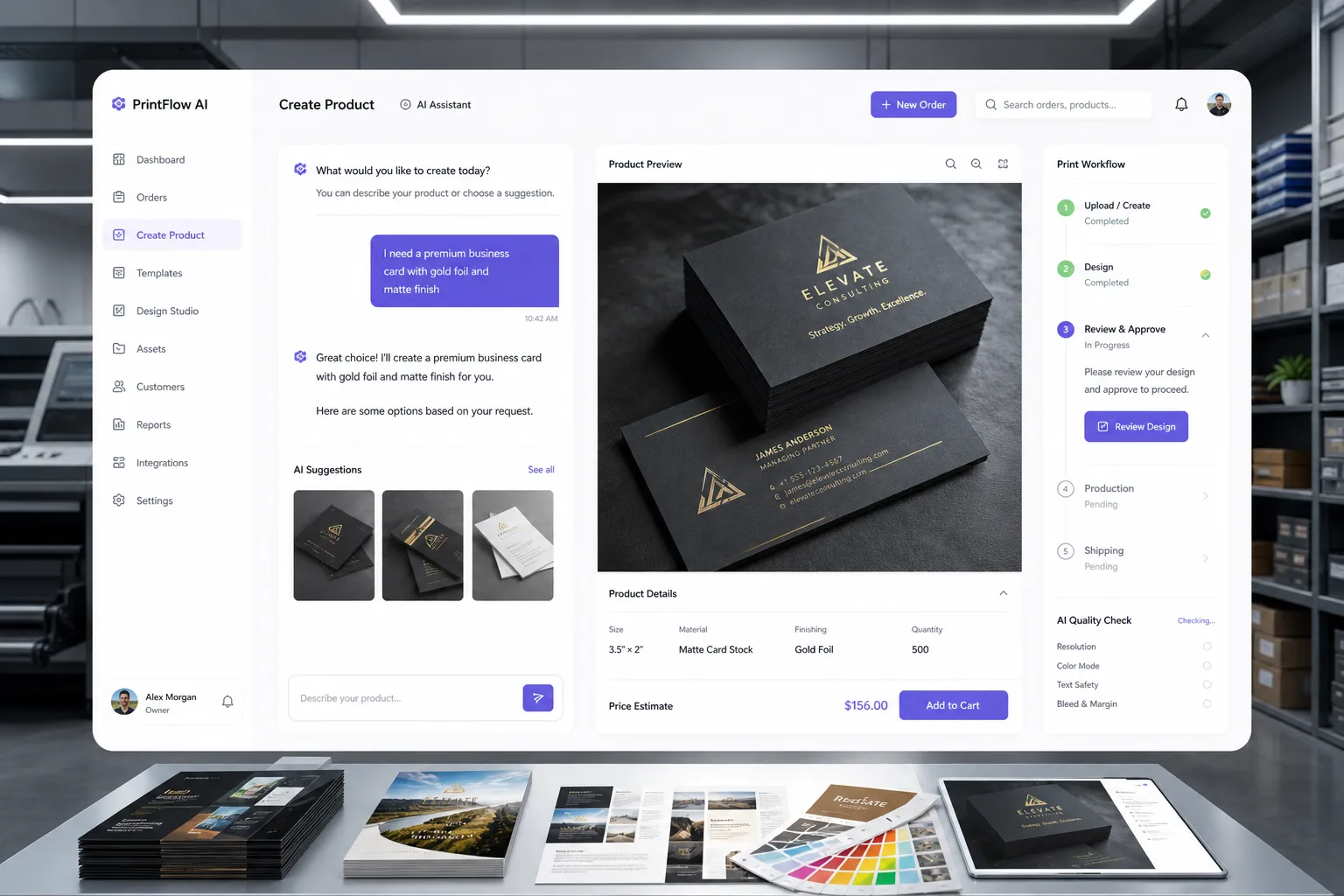
Modern web print software is no longer just an online ordering layer for print shops. In 2026, it is becoming the operating system for digital print growth: powering personalization, automation, AI-assisted creation, distributed fulfillment, and immersive product previews across every device.
For small studios, photographers, emerging print-on-demand brands, regional print providers, and established photo book companies, the shift is strategic. Customers now expect faster creation, easier customization, mobile-first experiences, and confidence before they buy. At the same time, print businesses need lower overhead, less manual intervention, and infrastructure that scales without expensive rebuilds.
That is exactly why the market is moving beyond legacy design editors and fragmented ordering tools. The next generation of web print platforms is built around frictionless creation, intelligent workflows, and cloud-connected production.
"The global web-to-print market was valued at USD 36.3 billion in 2025 and is projected to reach USD 52.9 billion by 2034." - IMARC Group
"80% of consumers are more likely to purchase from stores that offer personalized experiences." - easyappsecom.com
What the Top-Ranking Articles Get Right - and What They Miss
The strongest competitor content agrees on a few core themes:
digital printing and short runs are accelerating
automation is replacing manual prepress and job handling
personalization is becoming central to conversion
web-to-print is increasingly tied to ecommerce
sustainability and on-demand production matter more each year
Those are all valid. But most articles stop at surface-level trend summaries. They rarely explain how modern web print software actually fits together, what a future-ready stack looks like, or why conversational AI and 3D/AR previews may reshape customer behavior more than traditional template editors ever did.
That is the real content gap in this topic.
In 2026, the winners will not just offer a web print portal with checkout. They will offer a complete creation-to-fulfillment ecosystem that reduces design friction, improves buyer confidence, and turns more visitors into paying customers.
Why Web Print in 2026 Is a Business Model, Not Just a Tool
A few years ago, businesses often treated a web print service as a convenience feature. It let customers upload files, reorder common products, or customize a few templates online.
Today, that mindset is too narrow.
A modern platform must support:
Capability | Old-School Approach | 2026 Expectation |
|---|---|---|
Product creation | Manual design tools | Conversational AI and smart automation |
Ordering | Static product pages | Guided, dynamic, personalized buying journeys |
Previewing | Flat mockups | Photorealistic 3D and AR previews |
Production | Batch planning and manual routing | Automated, on-demand fulfillment |
Access | Desktop-heavy workflows | Mobile-first, browser-based creation |
Infrastructure | One storefront, one team | White-label, multi-brand, multi-market scale |
In other words, web print software now sits at the intersection of SaaS, ecommerce, AI, and manufacturing automation.
The 10 Trends Defining Web Print Software in 2026
1. Conversational AI Is Replacing Complex Design Workflows
The biggest shift is not just better templates. It is the removal of design friction altogether.
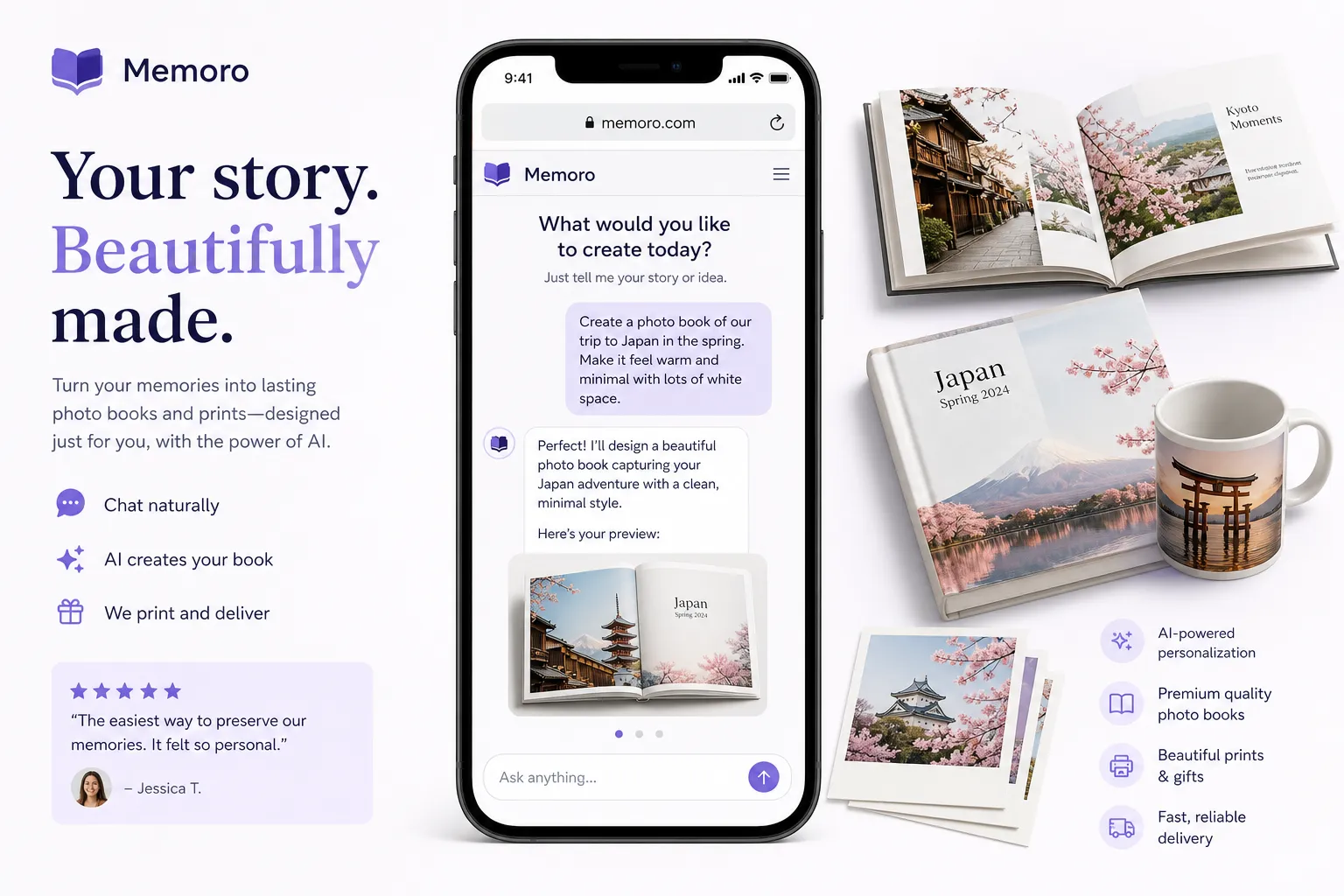
Instead of forcing customers to learn complex editors, drag-and-drop tools, bleed settings, or page logic, leading platforms now let them describe what they want in plain language. A user can type a prompt, upload photos, and receive a ready-to-print product with layouts, styling, and structure generated automatically.
This matters because most buyers do not want to become designers. They want a finished product quickly.
For print businesses, conversational AI creates several advantages:
faster time from interest to checkout
fewer abandoned sessions during customization
broader accessibility for non-designers
lower support burden on internal teams
higher conversion from mobile traffic
This is where Media Rex Alliance is especially relevant. Its autonomous creation engine allows end customers to create products through natural language rather than traditional design software. That means less friction, faster purchase decisions, and a dramatically more intuitive creation experience.
2. Mobile-First Creation Is Becoming Non-Negotiable
Many legacy platforms still behave like desktop software squeezed into a browser. That is a serious weakness in 2026.
Modern buyers discover, customize, and purchase on phones. If a web print portal is slow, cluttered, or dependent on a native app, conversion suffers.
The next wave of platforms is designed browser-first and mobile-first, with experiences that feel native without requiring installation. Users can start a project on a phone, continue on a tablet, and finalize on a laptop without losing progress.
That shift is especially important for:
photographers selling albums and prints
parents creating photo books from mobile galleries
creators launching merch or branded products
local print customers ordering signage or marketing collateral on the go
Media Rex Alliance aligns tightly with this direction by offering browser-based product creation with no app required, plus local and cloud sync for seamless multi-device continuity.
3. Photorealistic 3D and AR Previews Are Raising Conversion Confidence
A flat product thumbnail is no longer enough for premium print products.
As order values rise, so does buyer hesitation. Customers want to know what the finished item will actually look like before committing. This is especially true for photo books, wall art, packaging, branded merchandise, and other visually driven products.
That is why advanced web print software is moving toward:
real-time 3D previews
product rotation and material simulation
scale-aware visualization
AR placement in real environments
better representation of finishes, covers, and format
This is a major content gap in competitor articles. They mention personalization, but they often ignore confidence technology.
Confidence is conversion infrastructure.
When customers can see a photorealistic result before purchase, they are less likely to hesitate, abandon, or request post-order changes. Media Rex Alliance’s 3D and AR preview capability is particularly strong here, turning visualization into a revenue lever instead of a cosmetic add-on.
4. White-Label Deployment Is Beating Generic Marketplace Dependency
A generic marketplace may provide access, but it does not build enterprise value.
In 2026, more print businesses want to own the relationship, the customer data, the margin structure, and the brand experience. That is pushing demand toward fully white-label web print software that can integrate into an existing storefront, app, or digital product ecosystem.
This is especially valuable for:
photo book companies modernizing legacy platforms
regional printers expanding into branded ecommerce
studios and creator brands launching premium experiences
enterprise print organizations serving multiple sub-brands
A white-label system should support:
custom domains
full visual identity control
embedded workflows in existing storefronts
API-based extensibility
flexible catalog and pricing logic
Media Rex Alliance is built for this model. Instead of forcing businesses into a rigid front end, it enables branded deployment within their own digital environment, helping them launch faster without building the technology stack from scratch.
5. The Modern Web Print Server Is Becoming Invisible but Critical
Most buyers will never ask what powers a web print server, but every scaling business should.
In simple terms, the web print server is the operational core that handles requests, product logic, file orchestration, asset management, rendering, automation, and production handoff. In legacy systems, this layer often becomes fragile under complexity. Teams patch together plugins, scripts, separate proofing systems, and manual prepress checkpoints.
In 2026, that architecture is being replaced by more unified, cloud-native stacks.
A future-ready server layer should support:
high-volume rendering
smart asset processing
automated job ticket generation
API connectivity
real-time status handling
resilient multi-region performance
scalable security and permissions
The lesson for buyers is simple: if the front end feels elegant but the infrastructure behind it is brittle, growth will stall.
6. On-Demand Production Is Replacing Inventory-Heavy Print Models
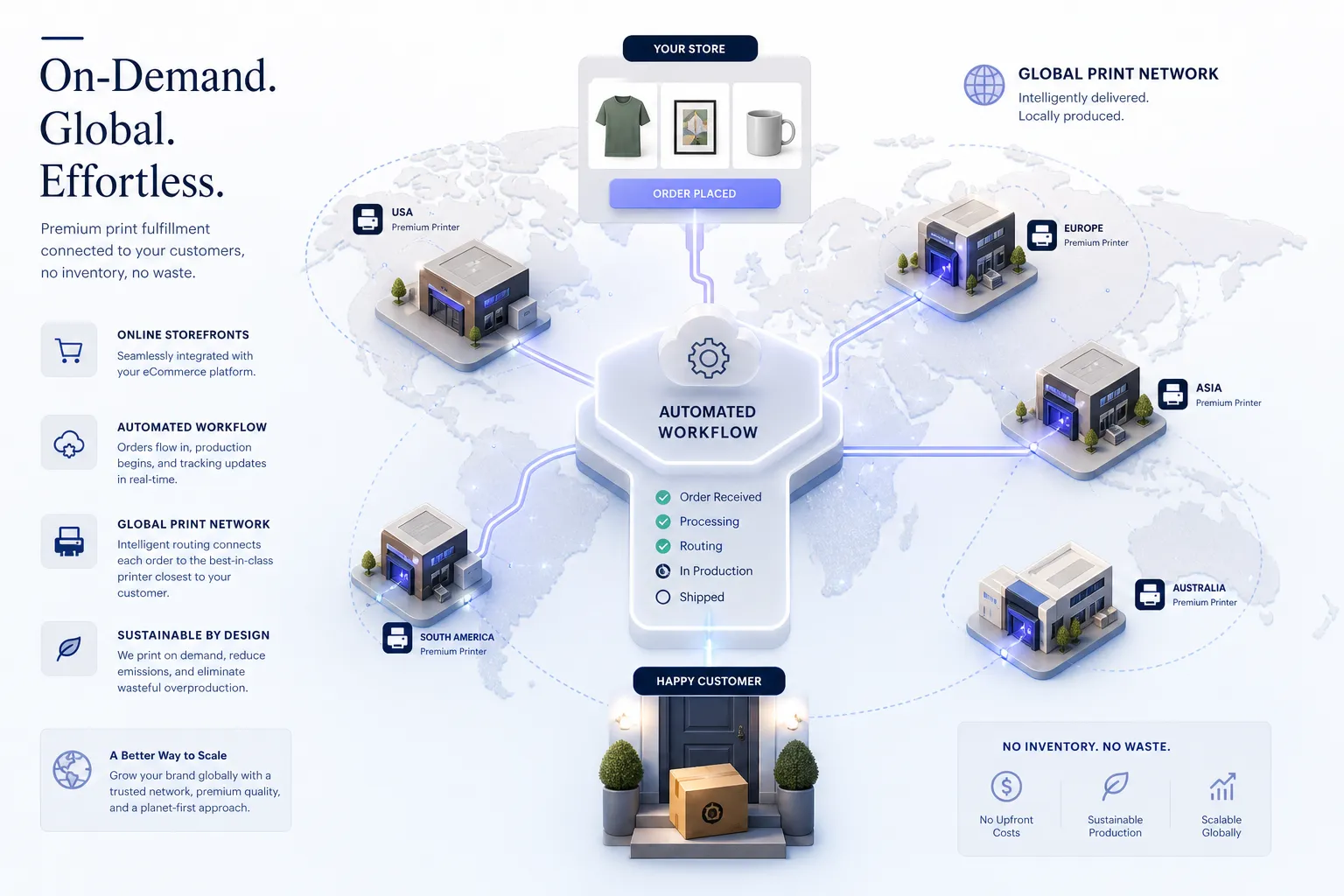
One of the strongest structural trends in web print is the move away from prebuilt inventory toward agile, on-demand fulfillment.
That shift solves several old problems at once:
capital tied up in unsold stock
version control challenges
warehouse and handling costs
waste from obsolete materials
difficulty testing new product lines
For a print business, this means a web print service can become far more experimental and scalable. You can launch products faster, validate demand earlier, and expand catalogs without multiplying overhead.
Media Rex Alliance is well positioned here because its model supports no-stock, low-overhead production and automated fulfillment through a global network of premium printers. That combination is increasingly attractive to growing brands that want reach without operational drag.
7. Automation Is Expanding Beyond Prepress Into Full Workflow Orchestration
Competitor articles often talk about automation, but usually in broad terms. In practice, the most important development is not isolated automation. It is end-to-end orchestration.
That includes automation across:
product setup
customer input handling
image enhancement
layout generation
proofing and previewing
routing to production partners
order tracking and notifications
This matters because partial automation still leaves labor-heavy bottlenecks. A truly modern web print portal should reduce manual touchpoints from creation through fulfillment.
The strategic benefit is not only efficiency. It is scalability. A business that relies on human intervention for every design correction or order transfer cannot grow profitably at the pace digital demand requires.
8. Personalization Is Moving From Variable Fields to Intelligent Product Creation
Traditional personalization meant changing a name, swapping an image, or editing a line of text. That still has value, but the market is moving further.
In 2026, personalization is becoming structural. The system does not just insert customer data into a template; it helps shape the product itself based on intent, content, audience, and context.
That can include:
auto-generated page sequences for photo books
layout selection based on image sets
tailored product suggestions by use case
localized creative variations
dynamic packaging or branded collateral
This is a key advantage for digital print businesses serving diverse customer segments. The more intelligently the system adapts the product creation journey, the more likely users are to complete a purchase.
Media Rex Alliance’s conversational model is powerful here because it transforms prompts and uploads into print-ready outputs rather than stopping at template customization.
9. Integration Flexibility Is Becoming a Major Buying Criterion
A modern web print portal cannot operate as an island.
It needs to connect with ecommerce systems, PIM layers, DAM tools, analytics platforms, order management systems, CRM environments, and fulfillment networks. Businesses evaluating web print software in 2026 increasingly care about interoperability as much as front-end features.
Here is what buyers should assess:
Integration Area | Why It Matters |
|---|---|
Ecommerce platform | Enables seamless customer journeys and unified checkout |
CRM and marketing tools | Supports segmentation, retention, and lifecycle campaigns |
DAM or media libraries | Simplifies photo and asset ingestion |
Fulfillment partners | Automates routing and production flow |
Analytics stack | Exposes funnel performance and drop-off points |
Identity/authentication | Supports secure white-label enterprise deployments |
This is especially important for established photo brands and larger print organizations modernizing legacy offerings. They do not need another disconnected tool. They need a platform layer that fits into a broader digital commerce strategy.
10. Sustainability Is Becoming Operational, Not Just Promotional
Sustainability remains a major trend, but the more meaningful shift is how it is being built into system logic.
Instead of treating sustainability as a brand message alone, leading print businesses are embedding it into production and fulfillment decisions through:
on-demand manufacturing
reduced spoilage
smarter routing
fewer physical proofs
shorter shipping paths when possible
lower overproduction risk
This is another reason modern web print software matters. Better orchestration leads to less waste.
A business that can create only what is ordered, route it intelligently, and avoid unnecessary inventory has a stronger environmental and financial model at the same time.
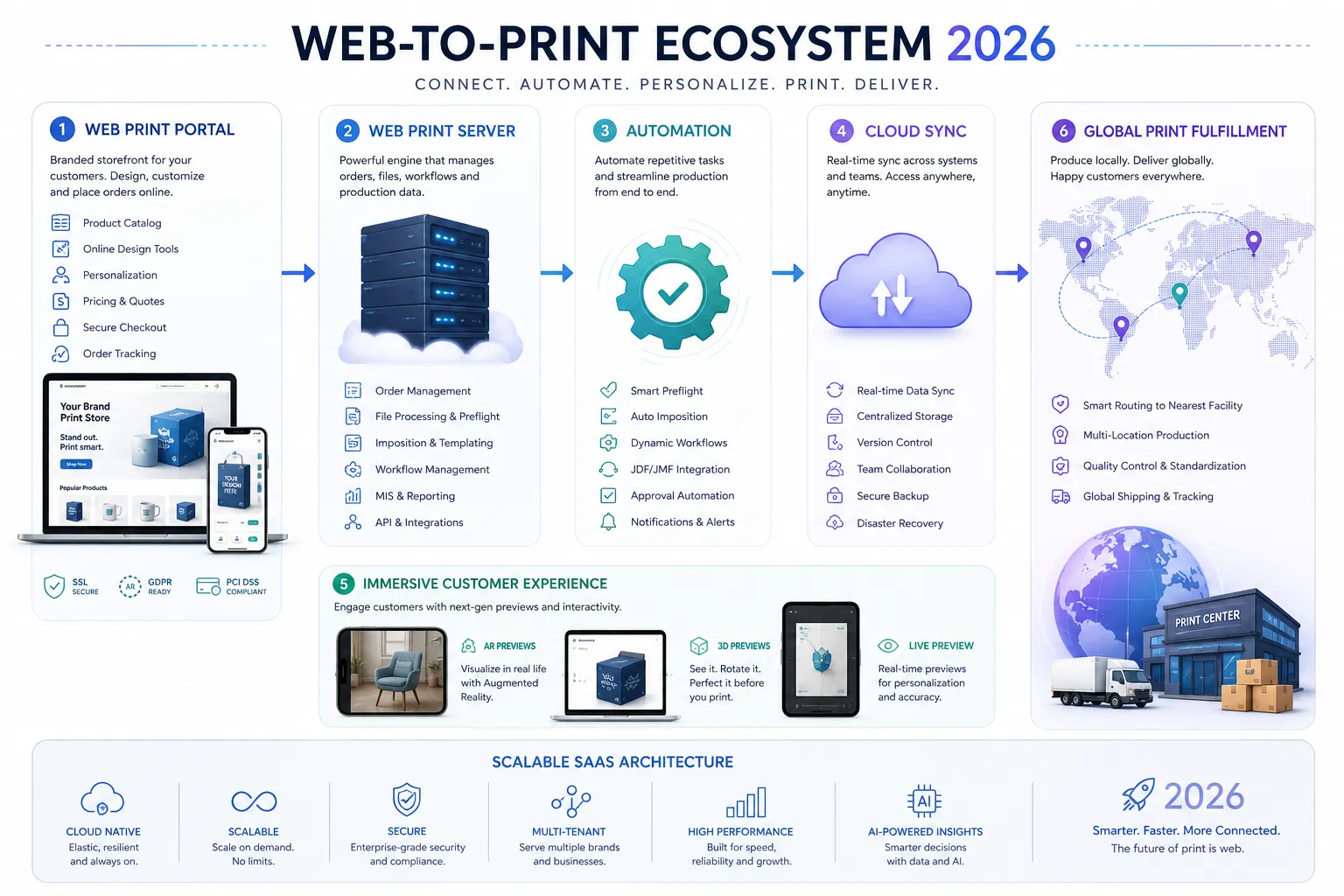
How a Scalable Web Print Ecosystem Actually Works
Many readers researching this topic encounter related terms like web print software, web print portal, web print service, and web print server without a clear explanation of how they connect.
Here is the simplest way to think about it:
Layer | Role in the Ecosystem |
|---|---|
Web print portal | The branded customer-facing interface where users create, customize, and order |
Web print software | The broader application layer that powers creation, logic, pricing, workflows, and integrations |
Web print server | The back-end infrastructure handling rendering, automation, job processing, assets, and system performance |
Web print service | The operational experience delivered to the customer, including ordering, proofs, production flow, and support |
The strongest 2026 platforms make these layers feel unified, not stitched together.
That is the standard businesses should now expect.
What Competitors Underestimate About the Future of Web Print
After reviewing the current top-ranking content, three major omissions stand out.
They Underplay the Role of Creation Friction
Most articles still assume customers are comfortable using templates or editors. In reality, friction during creation is one of the biggest causes of abandonment. Conversational AI is not a gimmick; it is a conversion strategy.
They Treat Visualization as a Nice-to-Have
Flat previews and static mockups are increasingly inadequate for premium print products. 3D and AR are quickly becoming important trust builders.
They Talk About Growth Without Talking About Ownership
Selling through third-party marketplaces may generate demand, but long-term growth comes from owning the brand experience. White-label deployment and embedded product creation matter more than ever.
What to Look for When Choosing Web Print Software in 2026
If you are evaluating platforms this year, use a stricter standard than the market did even two years ago.
Prioritize These Core Capabilities
natural-language product creation
mobile-first browser experience
white-label deployment flexibility
photorealistic previews and AR support
cloud and local project continuity
automated fulfillment workflows
scalable integration architecture
on-demand production economics
Ask Harder Questions
How many manual steps still exist between creation and production?
Can non-designers complete a product without help?
Does the system increase confidence before checkout?
Can the experience live inside our existing storefront or app?
Will this architecture scale across brands, markets, or product lines?
A modern platform should reduce both customer effort and internal complexity.
Why Media Rex Alliance Fits the Direction of the Market
Media Rex Alliance is aligned with the most important forces shaping web print in 2026 because it was designed around them from the start.
Rather than retrofitting an old editor with AI features, it approaches the problem differently:
customers create through conversational prompts instead of complex design tools
prompts are turned into print-ready products quickly, reducing friction and accelerating purchase decisions
businesses can deploy it as a fully white-label experience inside existing storefronts or apps
shoppers gain confidence through photorealistic 3D and AR previews before ordering
the experience is mobile-first, browser-based, and requires no app installation
projects sync locally and in the cloud for seamless multi-device use
the operating model reduces inventory and overhead through on-demand production
fulfillment can be automated through a global network of premium printers
the platform scales from lean startups to established enterprise print organizations
That combination makes it more than a design layer. It is infrastructure for AI-powered print commerce.
Final Verdict: The Future of Web Print Belongs to Frictionless Creation
The most important trend shaping 2026 is not just automation, personalization, or ecommerce integration on its own.
It is the convergence of all three into a simpler buying experience.
The future of web print belongs to platforms that help customers go from idea to finished product with minimal effort and maximum confidence. That means conversational creation, immersive previews, white-label flexibility, browser-based access, and automated fulfillment working together as one system.
For print businesses that want to modernize without building everything in-house, this is the moment to move. Media Rex Alliance gives you a faster path to an AI-powered, scalable, branded print experience that matches where the industry is going.
If your current stack still depends on manual design friction, disconnected tools, or inventory-heavy workflows, 2026 is the year to upgrade your model, not just your interface.