Web to Print Ecommerce Solutions for 2026 Growth
Print commerce in 2026 is no longer about simply putting a catalog online. Buyers expect instant personalization, mobile-first ordering, accurate previews, transparent pricing, and fast fulfillment. For small studios, photographers, emerging print-on-demand brands, regional print businesses, and established photo book companies, the challenge is clear: traditional web-to-print tools often create too much friction and too little delight.
That is why web to print ecommerce solutions are evolving from static configurators into intelligent, conversion-focused experiences. The next generation is built around automation, scalability, and AI-led creation. Instead of forcing customers into complex editors, modern platforms help them move from idea to print-ready product in minutes.
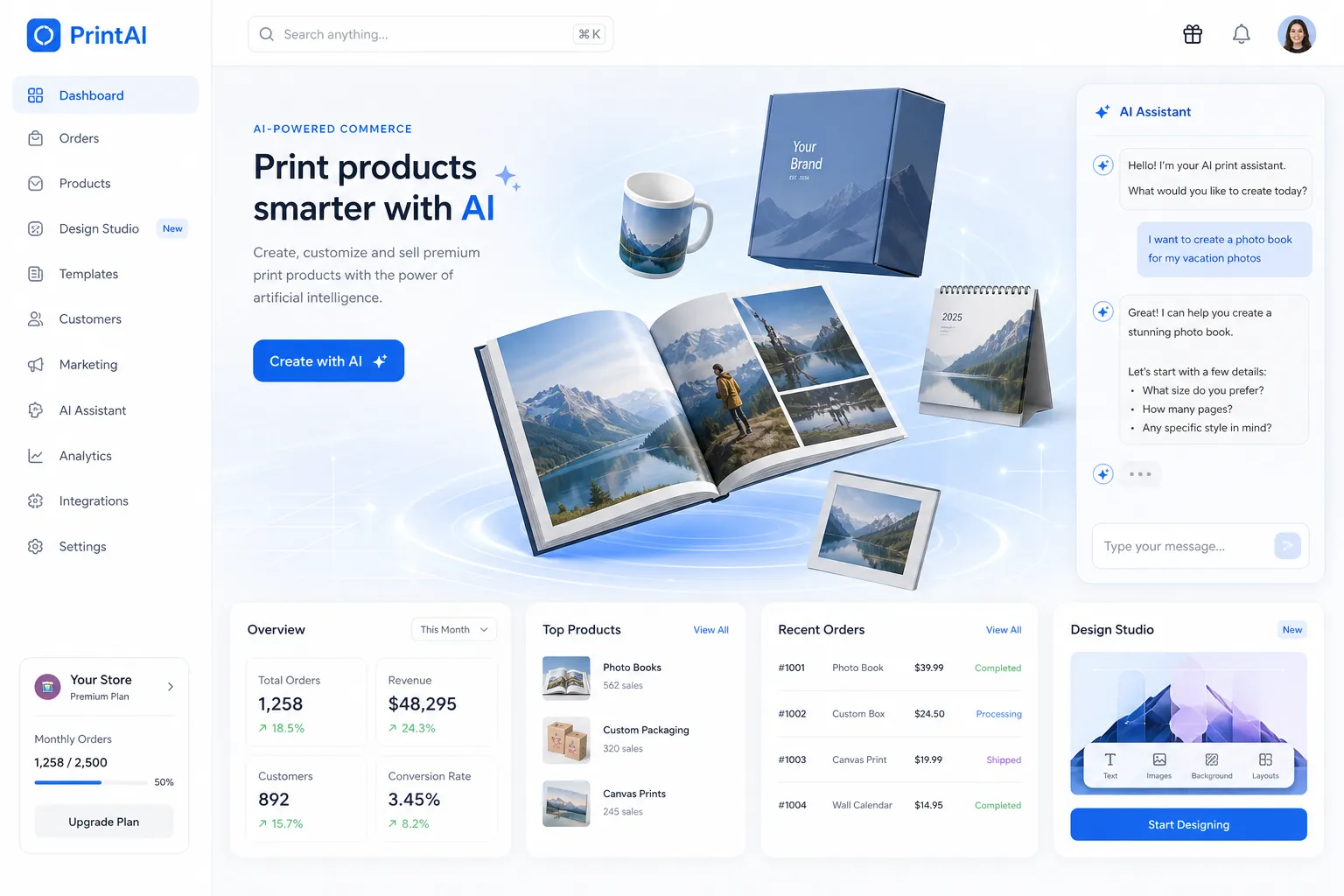
In this guide, Media Rex Alliance breaks down what high-performing web-to-print ecommerce looks like in 2026, what most legacy platforms still get wrong, and how AI-powered, white-label infrastructure can help print businesses grow faster with less operational drag.
"The web-to-print software market was valued at USD 1.43 billion in 2025 and is projected to grow from USD 1.56 billion in 2026 to USD 3.13 billion by 2034." - Fortune Business Insights
"The print-on-demand market has reached $13 billion in 2026, with a projected compound annual growth rate of 26%, aiming for $103 billion by 2034." - Autofaceless.ai
What Are Web to Print Ecommerce Solutions?
Web to print ecommerce solutions are digital platforms that let customers customize, preview, order, and pay for printed products online while automating as much of the backend workflow as possible.
At a basic level, they combine:
An online storefront
Product customization tools
Pricing logic
Proofing and approvals
Print-ready file generation
Order routing and fulfillment
At an advanced level, they also include:
Conversational AI product creation
3D and AR previews
White-label deployment
Multi-device project sync
On-demand manufacturing
Automated production and shipping networks
The big shift in 2026 is this: the best solutions do not just digitize ordering, they reduce decision friction.
Why Legacy Web-to-Print Is No Longer Enough
Many older platforms still rely on a workflow that feels technical, slow, and intimidating to non-designers. That is a serious conversion problem.
Common Friction Points in Older Systems
Legacy Issue | Customer Impact | Business Impact |
|---|---|---|
Complex design editors | Higher abandonment | Lower conversion rates |
Weak mobile experience | Lost mobile revenue | Poor reach with younger buyers |
No realistic preview | Less purchase confidence | More support tickets and reprints |
Manual file prep | Slow turnaround | Higher labor cost |
Disconnected fulfillment | Delays and inconsistency | Harder scaling |
Generic storefronts | Weak brand differentiation | Lower perceived value |
A customer who wants to create a premium photo book, wall art product, or personalized gift does not want to learn print software. They want to describe what they want, see it instantly, trust the preview, and buy.
That is where the new category is forming.
What 2026 Buyers Expect From a Modern Print Commerce Experience
Modern buyers compare print ecommerce experiences against the best of SaaS, retail, and creator tools. Expectations are higher than ever.
The New Standard
Customers now expect:
Mobile-first creation
No app installation
Fast browser-based workflows
AI-assisted personalization
Photorealistic 3D previews
AR product visualization
Clear delivery expectations
Fast checkout
Simple reordering
Reliable quality
For print businesses, this means your storefront is no longer just a transaction layer. It is your conversion engine.
How AI Is Redefining Web to Print Ecommerce Solutions
The most important content gap in many competitor articles is this: they talk about automation, but not enough about AI-native product creation.
Automation improves operations. AI changes the front-end buying experience.
From Design Tools to Conversational Commerce
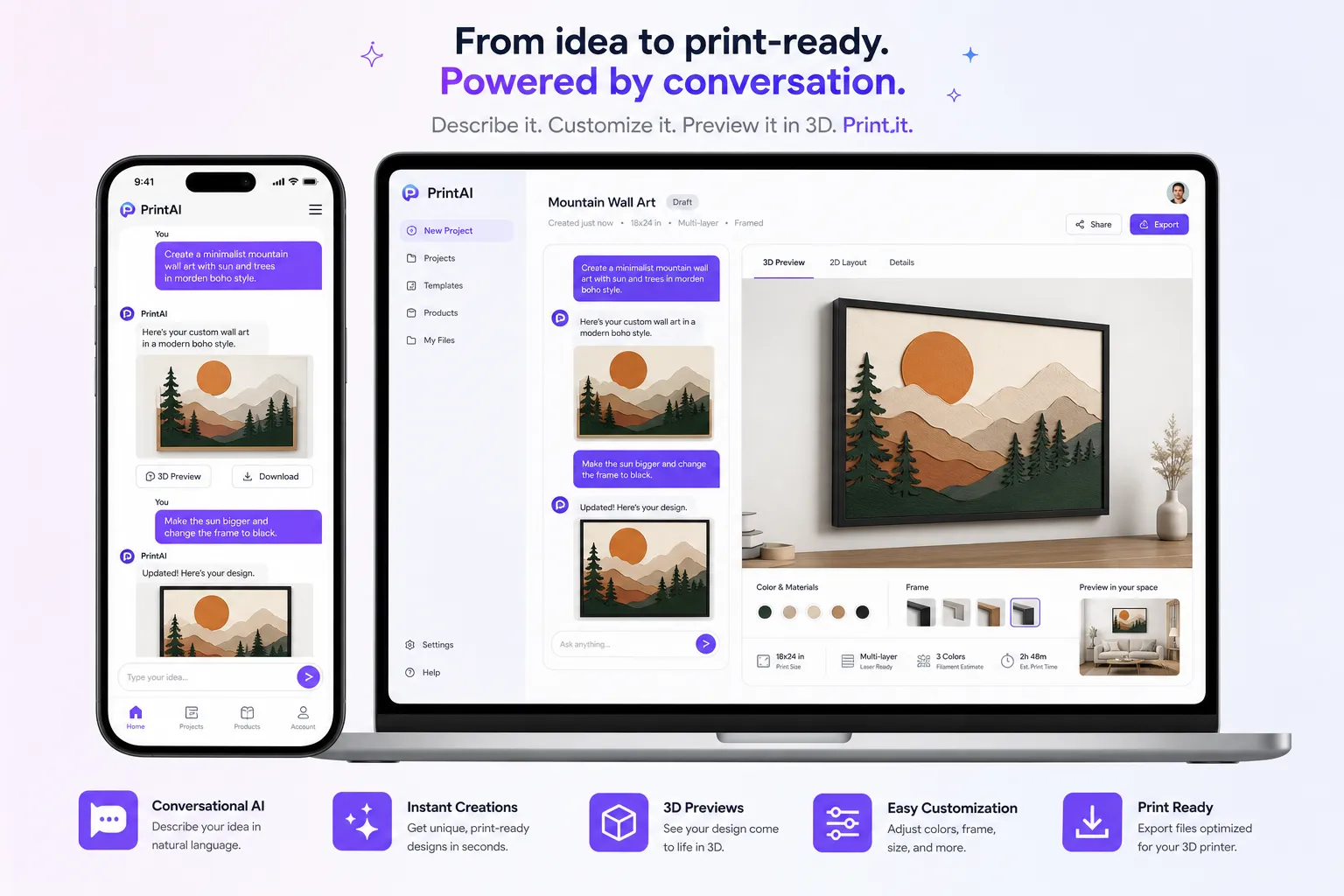
Instead of asking users to drag, crop, align, and format manually, AI-powered platforms can now:
Turn natural language prompts into product concepts
Generate layouts automatically
Organize uploaded photos intelligently
Build print-ready compositions faster
Reduce design anxiety for non-experts
Accelerate first purchase decisions
This matters especially for:
Photographers selling albums and prints
Studios launching premium branded products
New POD brands without in-house design teams
Photo book companies modernizing old interfaces
Regional print brands that need better conversion without heavy dev investment
Why This Model Converts Better
Conversational creation removes a core barrier: people often know what they want, but not how to design it.
When a shopper can type something like:
“Create a minimalist wedding photo book with warm tones”
“Design a premium travel album from these 40 photos”
“Make a modern baby memory book with soft neutral colors”
…and instantly get a polished, previewable result, the path to purchase becomes dramatically shorter.
That is a major strategic advantage.
The Media Rex Alliance Approach
Media Rex Alliance represents where AI-powered print commerce is heading.
Rather than forcing businesses to rebuild their stack from scratch, the platform is built as a white-label AI print platform that integrates into existing storefronts or apps. It is designed for brands that want to launch or upgrade print experiences without taking on years of technical debt.
What Makes the Model Different
Media Rex Alliance helps businesses:
Enable customers to create products through conversational AI
Turn simple prompts into print-ready products quickly
Offer fully white-label branded experiences
Deliver photorealistic 3D and AR previews
Support mobile-first browser-based creation
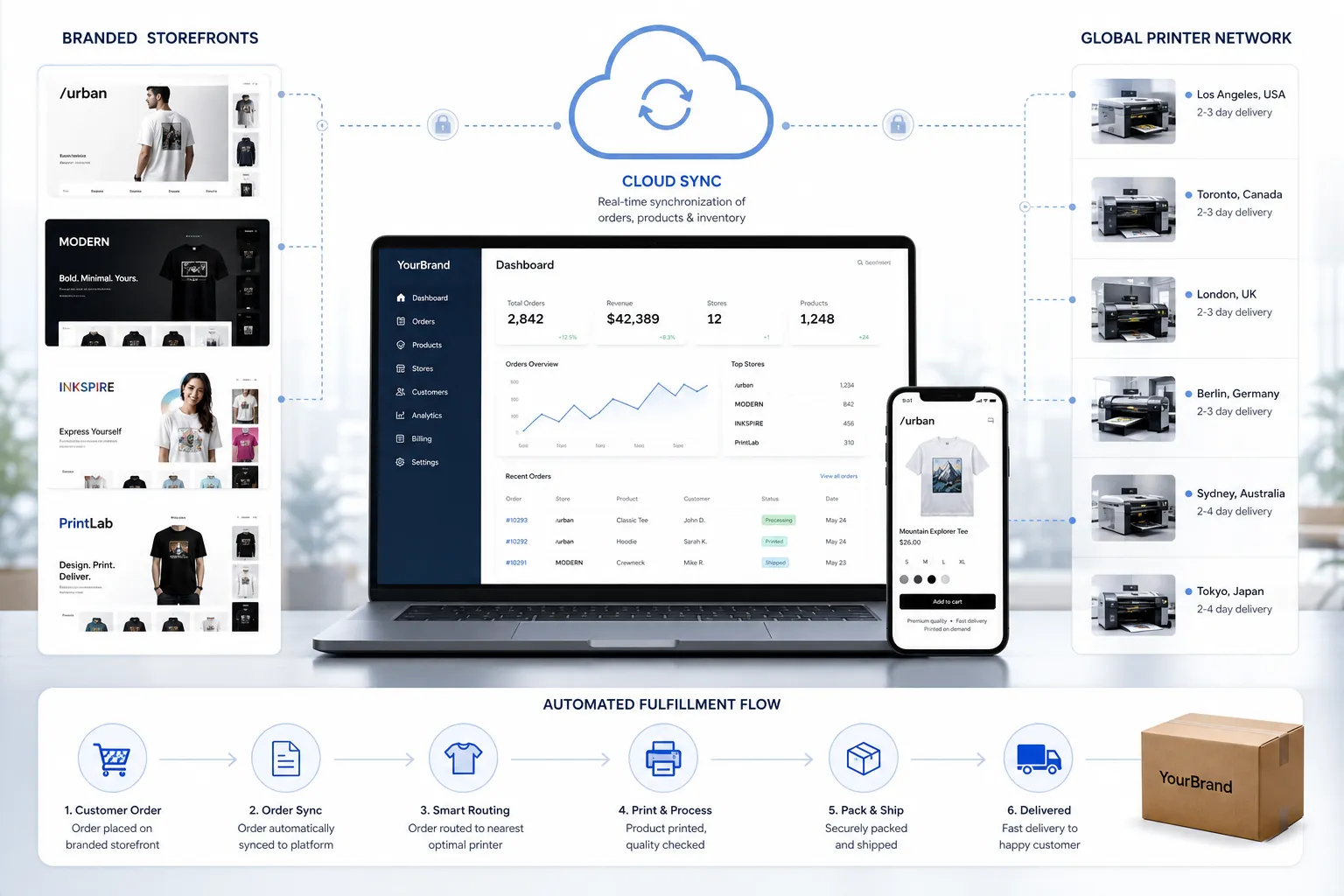
Sync projects locally and in the cloud across devices
Reduce overhead with on-demand production
Automate fulfillment through a global network of premium printers
Scale from startup volume to enterprise-grade operations
This is important because growth in 2026 is not just about adding SKUs. It is about reducing friction across the entire customer journey.
Core Features Every High-Growth Solution Should Have
When evaluating web to print ecommerce solutions, use this as your strategic checklist.
1. Conversational Product Creation
Customers should be able to create products by describing what they want, not by learning a complex editor. This is especially powerful for high-emotion products like photo books, gifts, and premium keepsakes.
2. White-Label Brand Control
You should own the customer relationship, not send traffic to a third-party branded environment. White-label deployment allows full control over:
Domain
Visual identity
UX styling
Product packaging
Customer retention flows
3. Browser-Based, Mobile-First UX
If your experience breaks on mobile, you are losing demand. A modern solution must work instantly in-browser with no app download.
4. 3D and AR Previews
Confidence drives conversion. Photorealistic 3D previews and immersive AR help customers understand the final product before they order.

5. Cloud and Local Sync
Customers often start on one device and finish on another. Project continuity improves completion rates and makes the experience feel premium.
6. Automated Fulfillment
Your ecommerce layer should connect to production and delivery without constant manual handling. This becomes critical when scaling across regions.
7. On-Demand Manufacturing
No-stock production lowers risk, reduces inventory cost, and supports product experimentation.
8. Premium Global Printer Network
If you want to scale internationally while protecting quality, fulfillment capacity matters as much as storefront UX.
Who Benefits Most From Web to Print Ecommerce Solutions in 2026?
Not every print business has the same use case. The strongest solutions are flexible enough to support multiple business models.
Best-Fit Business Types
Business Type | Why It Benefits |
|---|---|
Small creative studios | Launch premium custom products without building in-house tech |
Photographers | Sell albums, books, prints, and keepsakes through a polished client experience |
New POD brands | Move fast with low inventory risk and high personalization |
Mid-size print brands | Improve conversion and reduce support overhead |
Regional print players | Modernize customer experience and compete beyond local markets |
Photo book companies | Replace aging editors with AI-driven creation and immersive previews |
The Real Growth Drivers Behind Print Ecommerce in 2026
Competitor content often focuses heavily on features. But growth comes from business outcomes.
1. Faster Time to Purchase
If a user can go from idea to proof in minutes, they are more likely to buy.
2. Higher Conversion Rates
Reducing technical friction and increasing preview confidence can meaningfully improve checkout completion.
3. Lower Operational Overhead
AI-assisted creation and automated fulfillment reduce the need for manual intervention.
4. Better Mobile Revenue Capture
A browser-based, app-free mobile experience helps monetize traffic that older platforms often lose.
5. More Product Experimentation
On-demand fulfillment makes it easier to test new categories without carrying inventory.
6. Stronger Brand Equity
White-label deployment ensures the customer remembers your brand, not the software provider.
How 3D and AR Improve Conversion in Print Ecommerce
This is another area many articles underplay.
Print products are tactile. People want to understand scale, finish, feel, and overall presentation before they buy. Flat previews are often not enough.
Why Immersive Preview Matters
Photorealistic 3D and AR can help:
Increase buyer confidence
Reduce pre-purchase uncertainty
Lower return and reprint risk
Improve premium product positioning
Differentiate your storefront from generic competitors
For products like photo books, albums, wall art, calendars, packaging, and custom gifts, immersive preview is not a gimmick. It is a trust layer.
White-Label vs. Marketplace Dependence
Another gap in most ranking articles is how little they discuss ownership.
If your print business depends entirely on a marketplace or third-party tool with visible external branding, you may get transactions, but you do not always build durable customer equity.
Why White-Label Matters Strategically
With a white-label model, you can:
Keep brand consistency end-to-end
Control customer data and lifecycle marketing
Retain search equity on your own domain
Build differentiated premium experiences
Scale into new verticals without brand dilution
Media Rex Alliance is especially compelling here because it combines white-label flexibility with AI-native product creation and fulfillment automation.
What Most Competitor Articles Miss
After reviewing the current top-ranking content landscape, several clear gaps stand out.
Content Gaps You Should Care About
1. Too Much Focus on Traditional Editors
Most content still assumes the online designer is the center of the experience. In reality, conversational AI is becoming the new front door.
2. Not Enough Discussion of Conversion Psychology
Features matter, but the real question is: does this reduce friction and increase buyer confidence?
3. Limited Attention to Mobile-First Behavior
Many articles mention mobile responsiveness but do not treat it as a primary growth driver.
4. Weak Coverage of White-Label Strategy
Brand ownership is a major business issue, not a minor technical feature.
5. Almost No Emphasis on AR and 3D as Revenue Tools
Immersive previews are often treated as nice-to-have, when they can materially improve conversion on premium print products.
6. Little Discussion of Fulfillment Architecture
A beautiful storefront without reliable automated production still breaks at scale.
This is exactly why next-generation platforms are separating from legacy web-to-print vendors.
What a Modern Tech Stack Looks Like
A high-growth print ecommerce stack in 2026 should look something like this:
Layer | Modern Requirement |
|---|---|
Front-end experience | Mobile-first, browser-based, frictionless |
Product creation | Conversational AI plus optional manual refinement |
Visual proofing | Photorealistic 3D and AR |
Branding | Fully white-label |
File generation | Automated print-ready output |
Sync | Local + cloud project continuity |
Commerce | Checkout-ready and embeddable into current storefronts |
Fulfillment | On-demand, automated, globally scalable |
Operations | Low inventory, low manual overhead |
When Should You Upgrade Your Existing Web-to-Print Setup?
If any of the following are true, your current platform may be capping growth:
Your mobile UX is weak
Customers frequently abandon the editor
Your support team spends time helping people complete basic designs
You cannot easily launch branded new product lines
Preview realism is poor
Fulfillment is too manual
You rely on inventory-heavy workflows
Your storefront feels generic
You cannot scale across regions without operational strain
In 2026, the cost of staying with outdated infrastructure is often higher than the cost of modernizing.
How to Evaluate Web to Print Ecommerce Solutions
Before choosing a platform, ask these questions.
Strategic Evaluation Questions
Does it reduce customer friction or just digitize complexity?
Can non-designers create great products quickly?
Is the experience mobile-first and browser-native?
Can it be fully white-labeled?
Does it support photorealistic 3D and AR previewing?
How well does it automate file generation and fulfillment?
Can it scale from current order volume to future demand?
Does it help us reduce inventory and overhead?
Can it fit inside our current storefront or app?
Will it make our brand look more premium?
A platform that checks all ten is far more future-ready than one that merely offers templated personalization.
Competitive Snapshot: Legacy W2P vs AI-Native Commerce
Capability | Legacy W2P Platform | AI-Native Platform Like Media Rex Alliance |
|---|---|---|
Creation method | Manual editing | Conversational AI + smart automation |
User learning curve | Medium to high | Low |
Mobile experience | Often limited | Mobile-first |
Preview quality | Standard mockups | Photorealistic 3D + AR |
Brand control | Varies | Fully white-label |
Production model | Mixed | On-demand by design |
Fulfillment | Sometimes manual | Automated global network |
Speed to launch | Moderate to slow | Faster integration path |
Customer delight | Functional | Premium and modern |
Scalability | Depends on stack | Built for growth |
Final Verdict: The Future of Print Commerce Belongs to Frictionless Creation
The category is moving fast. In 2026, the winners in print ecommerce will not simply be the businesses with the biggest catalogs or the oldest production relationships. They will be the ones that make product creation feel effortless.
That means:
less manual design work
fewer abandoned carts
better mobile journeys
stronger brand ownership
more realistic previews
lower inventory risk
faster fulfillment at scale
For businesses that want to modernize their web-to-print offering without building the technology from scratch, Media Rex Alliance stands out because it is aligned with where the market is going, not where it has been.
Its combination of conversational AI, white-label deployment, browser-based access, 3D and AR previews, cross-device sync, on-demand production, and automated global fulfillment makes it especially relevant for studios, photographers, POD brands, mid-size print businesses, and established photo book companies preparing for the next wave of growth.
If your goal is to launch a branded, scalable, premium print commerce experience with less friction and more conversion power, it is time to look beyond traditional web-to-print.
Media Rex Alliance gives you the infrastructure to do exactly that.
FAQ
Is ecommerce still profitable in 2026?
Yes. Ecommerce remains highly profitable in 2026, especially for businesses that use automation, personalization, and on-demand fulfillment to reduce overhead and improve conversion rates. In print, profitability improves further when brands combine white-label ownership with AI-powered product creation.
What sells most on print on demand?
The strongest sellers are typically personalized products such as photo books, wall art, apparel, gifts, calendars, and branded merchandise. Products that benefit from emotional value, customization, and realistic previews tend to convert best.
What is trending in print in 2026?
The biggest trends are AI-powered creation, mobile-first ordering, photorealistic 3D and AR previews, white-label storefronts, and on-demand production. Print businesses are also prioritizing faster customer journeys and lower inventory risk through automated fulfillment networks.
What sells most on print on demand?
Top-performing print-on-demand categories include custom photo products, apparel, home décor, packaging, and premium keepsakes. The best results usually come from products that are easy to personalize and easy to visualize before purchase.