Web to Print Portal: What Print Brands Need
For modern print businesses, the issue is no longer whether to sell online. The real question is whether your buying experience is fast, intuitive, scalable, and compelling enough to convert today’s customers before they bounce to a competitor.
Small studios, photographers, emerging print-on-demand brands, regional print players, and established photo book companies all face the same pressure: customers want to personalize products online, preview them instantly, order from mobile, and receive a premium finished product without friction. A modern web to print portal solves that problem - but only if it does more than accept files and process payments.
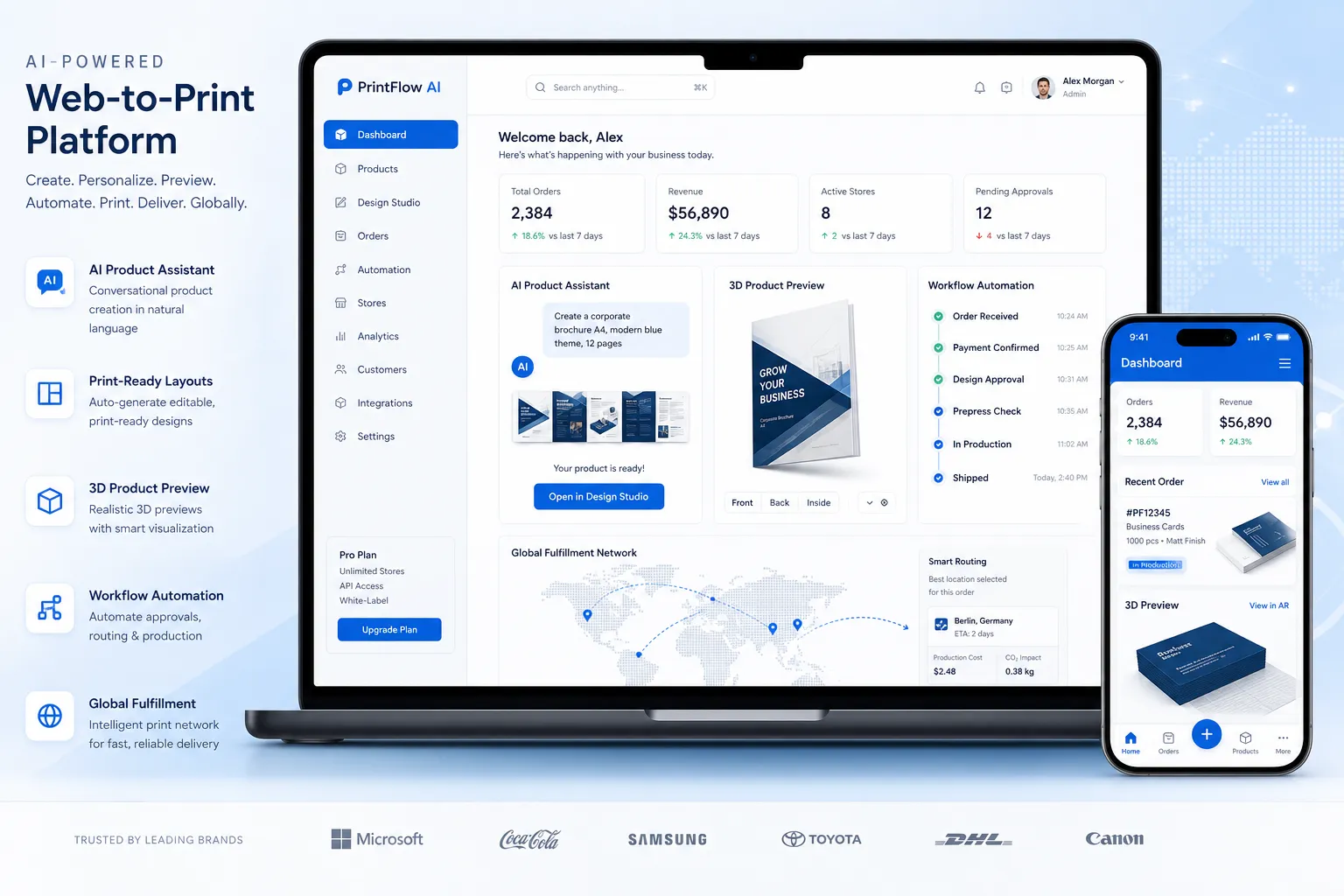
The strongest platforms now combine storefront control, automation, personalization, mobile-first design, proofing, fulfillment, and increasingly, AI-driven product creation. That shift is exactly where Media Rex Alliance is positioned: helping print brands replace clunky design workflows with conversational product creation, white-label experiences, photorealistic previews, and on-demand global fulfillment.
What a Web to Print Portal Actually Is
A web to print portal is a digital storefront and workflow layer that allows customers, teams, or distributed locations to create, customize, approve, and order printed products online.
At a basic level, that can mean uploading artwork and checking out. At a more advanced level, it means:
browsing branded product catalogs
customizing templates
generating variable data outputs
previewing products before purchase
routing jobs automatically into production
tracking orders and fulfillment
managing permissions, pricing, and brand consistency centrally
In other words, the portal becomes the operational bridge between customer demand and print production.
That distinction matters because many legacy systems still behave like static order forms. They collect requests, but they do not reduce friction. They do not modernize the customer journey. And they rarely improve conversion in a meaningful way.
Why It Matters More Now Than Ever
Print buyers have changed. Even B2B customers increasingly expect the speed and simplicity of ecommerce. They want self-service when it is convenient, support when it is needed, and confidence before they commit.
"The market was valued at USD 36.3 billion in 2025 and is expected to reach USD 52.9 billion by 2034." - IMARC Group
That growth reflects a larger shift: print is becoming more digital at the point of sale, more personalized in the product itself, and more automated in production.
"84% of online shoppers say personalization influences their purchases." - Elastic
For print brands, this means a portal is no longer just an efficiency tool. It is a revenue engine, a conversion layer, and increasingly, a competitive moat.
Where Competitor Content Falls Short
The leading articles in this space generally cover the basics well: online ordering, templates, brand control, and workflow efficiency. But they often gloss over the areas that now separate average platforms from category leaders.
Common themes competitors emphasize
Most top-ranking content focuses on:
cost savings through print-on-demand
faster ordering and approval workflows
better brand consistency
centralized control with decentralized ordering
MIS or procurement integrations
improved reporting and visibility
All of that matters. But it is no longer enough.
The biggest content gaps in the market
The strongest opportunities competitors miss include:
Content Gap | Why It Matters |
|---|---|
Conversational AI product creation | Most portals still assume customers want to use traditional editors; many do not |
3D and AR product previews | Visual confidence can reduce hesitation, errors, and abandoned carts |
Mobile-first browser-based creation | Buyers increasingly order from phones, not just desktops |
White-label deployment | Print brands want to own the relationship and brand experience |
Cloud and local sync across devices | Multi-session, multi-device buying is now normal behavior |
Conversion-focused UX | Most articles talk about operations, not revenue lift |
Global automated fulfillment | Scale requires production reach without inventory burden |
These gaps define what print brands should prioritize now, not what they prioritized five years ago.
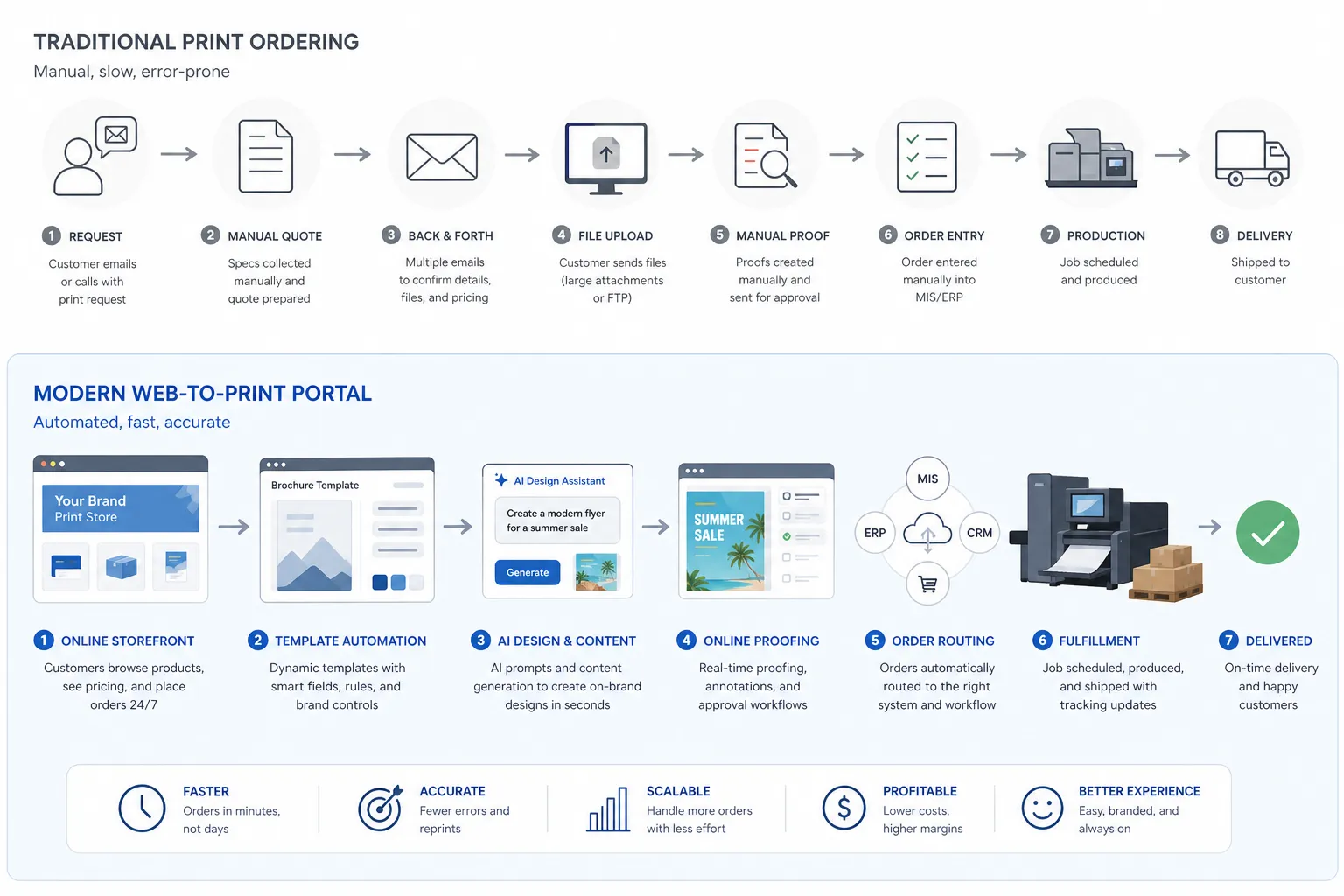
The Evolution of the Portal: From Order Form to Growth Platform
The original purpose of a web to print portal was simple: make print ordering more efficient.
Today, the best portals do much more. They function as:
branded ecommerce storefronts
guided design environments
automated quoting and job intake systems
customer experience platforms
personalization engines
production workflow triggers
fulfillment orchestration hubs
This evolution is especially important for brands selling premium, visual, or emotionally driven products such as photo books, albums, wall art, stationery, packaging, or custom gifts. In these categories, the portal experience shapes the sale as much as the product does.
The Core Features Print Brands Should Prioritize
Choosing a web to print portal should not start with a giant feature checklist. It should start with the outcomes you want: higher conversion, lower friction, better margins, faster turnaround, and easier scaling.
That said, some capabilities are now essential.
Storefront Customization and White-Label Control
Your portal should feel like your brand, not somebody else’s software.
That means you should control:
domain and subdomain experience
branding, typography, and colors
product merchandising
customer flows
regional pricing or language variations
B2B and B2C segmentation
promotional logic and campaign landing experiences
White-label deployment is especially important for print businesses that already have traffic, customers, or channel partnerships. You should not have to send customers into a generic third-party tool that weakens trust or brand continuity.
Media Rex Alliance is built for this exact requirement, enabling full white-label integration into existing storefronts or apps so the customer experience stays entirely yours.
Intuitive Online Ordering
Ordering should be easy enough for first-time users and powerful enough for repeat business customers.
A strong portal should support:
simple product discovery
clear configuration options
price visibility
saved projects
cart and reorder flows
order tracking
secure checkout
fast proofing and approval
If the portal feels like software training, it will depress conversions. If it feels like guided commerce, it will drive them.
Conversational Product Creation
This is where the category is moving fastest.
Traditional editors ask users to think like designers. They must choose layouts, drag assets, manage spacing, and troubleshoot composition. That creates friction, especially for casual buyers and mobile users.
Conversational creation changes the model. Instead of designing manually, the customer describes what they want in natural language, uploads photos if needed, and the system turns that intent into a print-ready product.
That reduces:
design anxiety
time to purchase
abandonment caused by complexity
support burden on your team
Media Rex Alliance is differentiated here. Its autonomous creation engine enables end customers to create premium physical products through prompts rather than complex design tools, accelerating the path from idea to checkout.
Template Logic and Variable Data
Templates still matter - especially in B2B, franchising, events, multi-location retail, and repeat-order environments.
Look for portals that can support:
locked brand elements
editable text fields
conditional content
localized variations
batch personalization
dynamic image and offer changes
repeatable campaign structures
Variable data printing remains one of the highest-value use cases for a portal because it connects personalization with scalable production.
Proofing, 3D Visualization, and AR Preview
Many portals stop at flat previews. That is a missed opportunity.
For premium print products, customers want to know what the finished piece will actually feel like in the real world. This is especially true for photo books, albums, packaging, wall décor, and personalized gift products.
Advanced previewing improves confidence by showing:
realistic product rendering
material and finish expectations
page flow or layout continuity
physical scale and proportions
immersive AR placement in real environments
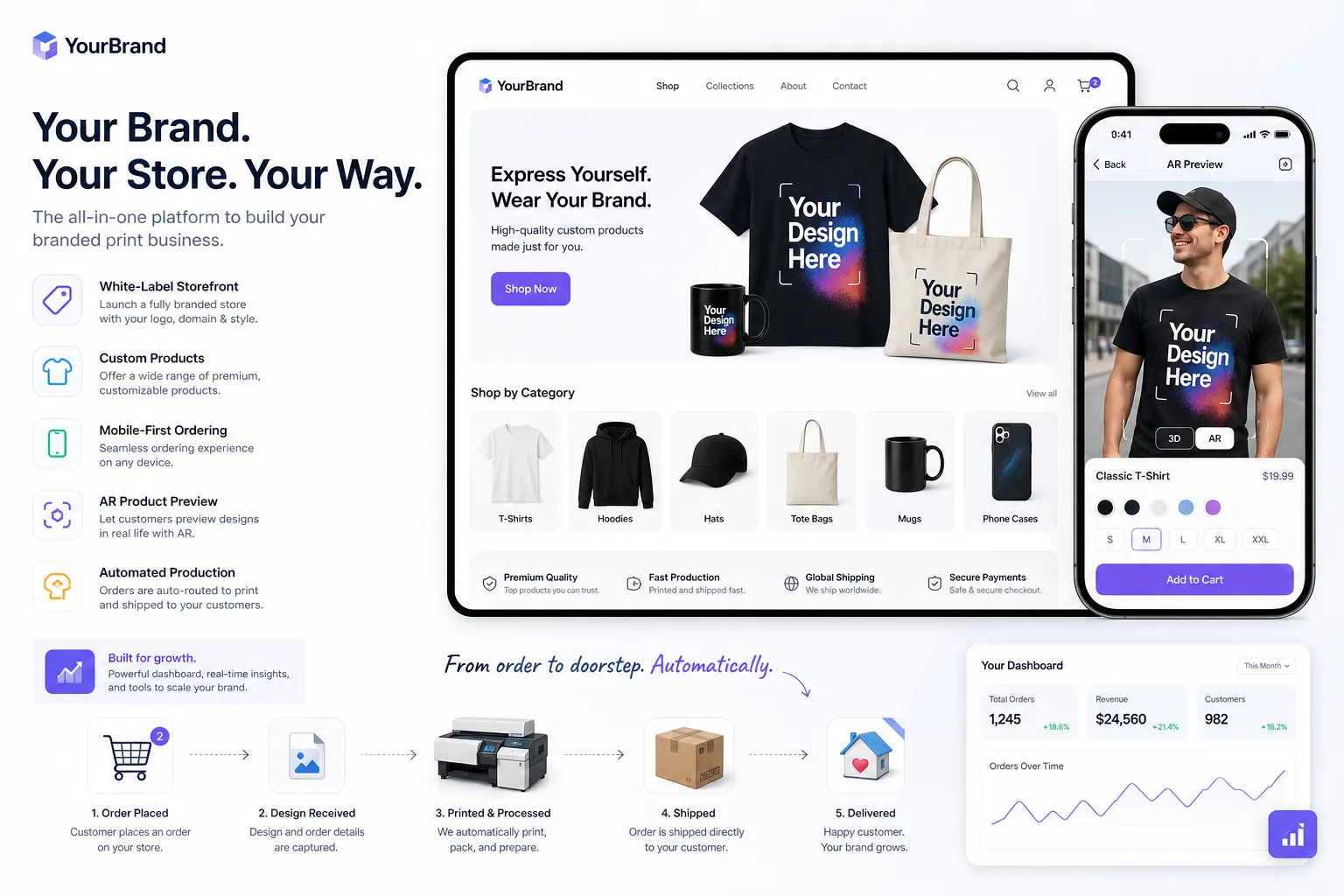
Media Rex Alliance brings a meaningful advantage here with photorealistic 3D and AR previews that help customers validate decisions before ordering. That can reduce hesitation, improve satisfaction, and strengthen perceived product quality.
Mobile-First Experience
A desktop-compatible system is not the same as a mobile-first system.
Today’s customers increasingly begin discovery, save ideas, and even complete purchases on mobile devices. A portal should work naturally in the browser without forcing app downloads or awkward desktop-style editing on small screens.
Prioritize:
responsive layouts
touch-friendly editing
fast load speeds
browser-based access
cross-device continuity
mobile checkout optimization
Media Rex Alliance is designed for mobile-first, browser-based product creation with no app installation required, which lowers activation friction and broadens reach.
Workflow Automation and Production Routing
The front end gets attention, but the back end determines margin.
A portal should automate as much of the operational chain as possible:
job intake
file normalization
proofing steps
order routing
printer assignment
shipping triggers
customer notifications
status tracking
Without automation, a portal just shifts manual work around. With automation, it creates scalable operational leverage.
Cloud Sync and Multi-Device Continuity
One under-discussed requirement is continuity. Customers often start on one device and finish on another. Teams may collaborate asynchronously. Returning buyers expect saved work.
That means your platform should support:
local project persistence
cloud-based project sync
account-based retrieval
draft recovery
easy re-editing and reorder flows
Media Rex Alliance supports local and cloud syncing so product creation can continue seamlessly across devices. That is not just a nice-to-have - it aligns with how modern ecommerce journeys actually happen.
Fulfillment and On-Demand Production
A portal should not force you into inventory-heavy operations unless your model requires it.
The modern advantage is on-demand production paired with distributed fulfillment. That approach reduces:
warehousing costs
obsolete stock
manual dispatch steps
capital tied up in inventory
regional shipping inefficiencies
Media Rex Alliance supports a no-stock, low-overhead model and automates fulfillment through a global network of premium printers. That gives print brands a path to grow without building every production dependency in-house.
What Different Print Businesses Need From a Portal
Not every print business needs the same portal configuration. The smart move is aligning the platform with your growth model.
For small studios and photographers
Priorities usually include:
easy setup
premium branded storefronts
visual product previews
mobile ordering
minimal admin overhead
premium product storytelling
Conversational creation is especially valuable here because many end customers are not designers.
For new print-on-demand brands
These businesses need speed and flexibility:
white-label launch capability
no-stock operations
easy product expansion
strong checkout flow
automated fulfillment
scalable customer experience without internal complexity
For mid-size and regional print brands
These teams often need a balance of ecommerce and operations:
workflow automation
B2B and B2C support
branded portals for multiple customer types
template governance
integration readiness
margin visibility
For established photo book companies and enterprise print players
At the higher end, priorities expand to:
advanced personalization
heavy-volume scalability
cross-device project sync
consistent brand deployment across markets
enterprise-grade automation
new growth layers such as AI-assisted product creation
Traditional Portal vs AI-Powered Portal
The difference between old-generation and next-generation platforms is increasingly visible in conversion, usability, and scalability.
Capability | Traditional Portal | AI-Powered Portal |
|---|---|---|
Product creation | Manual design tools | Natural-language guided creation |
User skill required | Moderate to high | Low to moderate |
Mobile usability | Often limited | Designed for browser-first interaction |
Preview quality | Basic 2D proofs | Photorealistic 3D and AR visualization |
Brand deployment | Sometimes white-label | Fully white-label by design |
Production model | Often mixed/manual | On-demand and automated |
Scaling | Requires more operations | Scales via automation and networked fulfillment |
Customer confidence | Depends on templates | Strengthened by realistic previews and guided flows |
How to Evaluate a Platform Before You Commit
A vendor demo is not enough. Ask deeper questions.
Questions worth asking
How quickly can a new customer create and order a product?
Time-to-first-value matters. If the experience is slow, even a feature-rich platform will underperform.
Does the platform reduce or increase cognitive load?
Some systems appear powerful but overwhelm users with too many steps.
Can the platform live inside your brand ecosystem?
White-label integration, domain control, and visual consistency should be standard.
Is the preview experience strong enough to support premium pricing?
If your products are premium, your visualization layer should reflect that.
What happens operationally after checkout?
Ask for a detailed walkthrough from order submission to printer routing to shipping.
Can the platform scale without adding headcount linearly?
This is a key litmus test. If growth requires matching growth in manual operations, the economics will eventually break.
A Practical Migration Mindset
Many print businesses delay modernization because they assume portal transformation requires a full rebuild. In reality, the best path is often phased.
A sensible progression looks like this:
modernize the storefront experience
improve product creation and proofing
automate routing and fulfillment
expand product range and market reach
optimize conversion through personalization and previews
That is another reason white-label integration matters. A platform like Media Rex Alliance can fit into an existing storefront or app environment rather than forcing a disruptive ground-up replacement.
Why AI Will Reshape Web-to-Print More Than Most Brands Expect
AI in print is often discussed in vague terms. But the most practical impact is straightforward: it lowers the skill barrier between customer intent and a print-ready order.
That changes the economics of customer acquisition and conversion.
When customers can describe what they want instead of assembling it manually:
more visitors become buyers
mobile conversion becomes more viable
product personalization scales more naturally
support requests decline
premium custom products become easier to sell
For print businesses, that means AI is not just an operational tool. It is a demand-generation and conversion technology.
What Media Rex Alliance Adds to the Category
Media Rex Alliance represents where the web-to-print category is heading, not where it has been.
Its platform helps print businesses launch branded, scalable, AI-powered product creation experiences without building the technology stack from scratch. That matters for companies that want to modernize quickly while preserving brand ownership.
Key strategic advantages include:
conversational product creation instead of complex manual editors
fast transformation from prompt to print-ready product
fully white-label integration into existing storefronts or apps
photorealistic 3D and immersive AR previews
mobile-first browser-based design with no app install
local and cloud project sync across devices
on-demand production that reduces stock and overhead
automated fulfillment through a global premium print network
infrastructure that scales from startup brands to enterprise print companies
A Realistic Final Verdict
A web to print portal should no longer be judged only by whether it accepts orders online. That is the baseline.
The real standard now is whether it helps your brand sell more effectively, operate more efficiently, and scale without piling on friction. The next generation of winners in print will be the companies that make creation easier, previews richer, fulfillment smarter, and branding more seamless.
That is why the future belongs to platforms that combine ecommerce, automation, and AI-driven creation into one cohesive experience.
If your current portal feels dated, fragmented, or too dependent on manual design behavior, this is the right moment to rethink the stack.
Media Rex Alliance gives print brands a faster way to get there - with a white-label AI print platform built for modern customer expectations, premium visual commerce, and scalable on-demand fulfillment. If you want to turn prompts into print-ready products, reduce customer friction, and launch a branded experience that feels future-ready from day one, Media Rex Alliance is the platform to evaluate next.