Web To Print Services: Best Platforms for 2026
The definition of a great web to print shop has changed.
In 2026, buyers are no longer impressed by a basic product configurator and a file upload button. They expect faster creation, mobile-first ordering, instant previews, flexible personalization, and a smoother path from idea to checkout. At the same time, print businesses need more than storefront software. They need scalable web to print services that reduce manual work, improve conversion rates, and support profitable on-demand fulfillment.
That is why the market is shifting away from static web-to-print tools and toward intelligent web to print platforms that combine automation, AI, white-label deployment, and global production networks.
This guide breaks down what the best platforms are doing differently in 2026, what features actually matter, and how to choose the right solution if you are a studio, photographer, print-on-demand startup, regional print brand, or established photo product company modernizing your digital storefront.
Why web to print services matter more in 2026
Traditional online print workflows still create too much friction:
customers struggle with complex editors
mobile conversion is weak
file prep is confusing
product personalization takes too long
internal teams waste time on proofing and support
launching a branded print experience from scratch is expensive
Modern buyers want to describe what they want, see it instantly, and order with confidence. Modern print businesses want to launch faster, keep overhead low, and scale without rebuilding their stack every year.
This is where next-generation web to print services stand apart. The best solutions now combine:
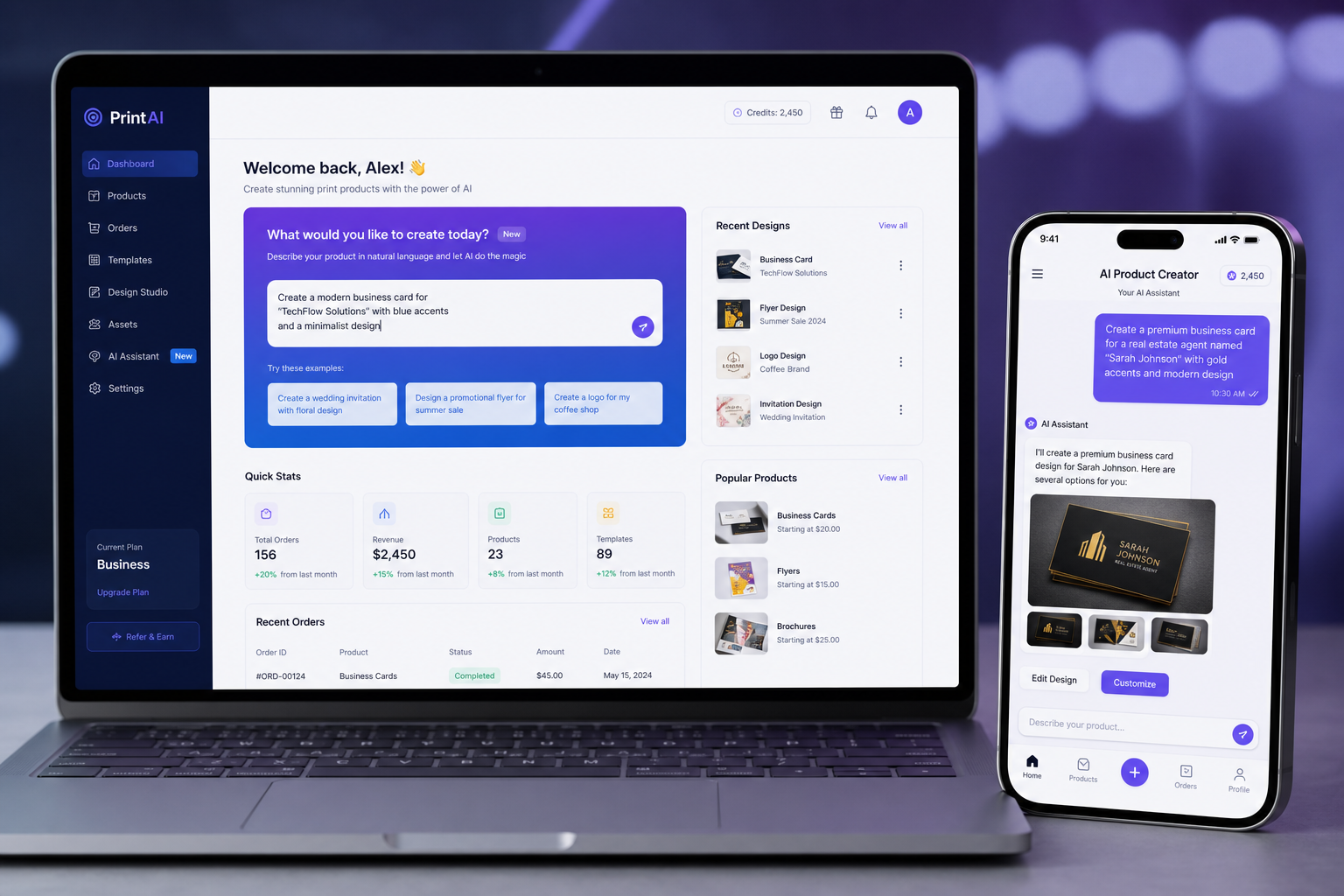
conversational product creation
automated layout generation
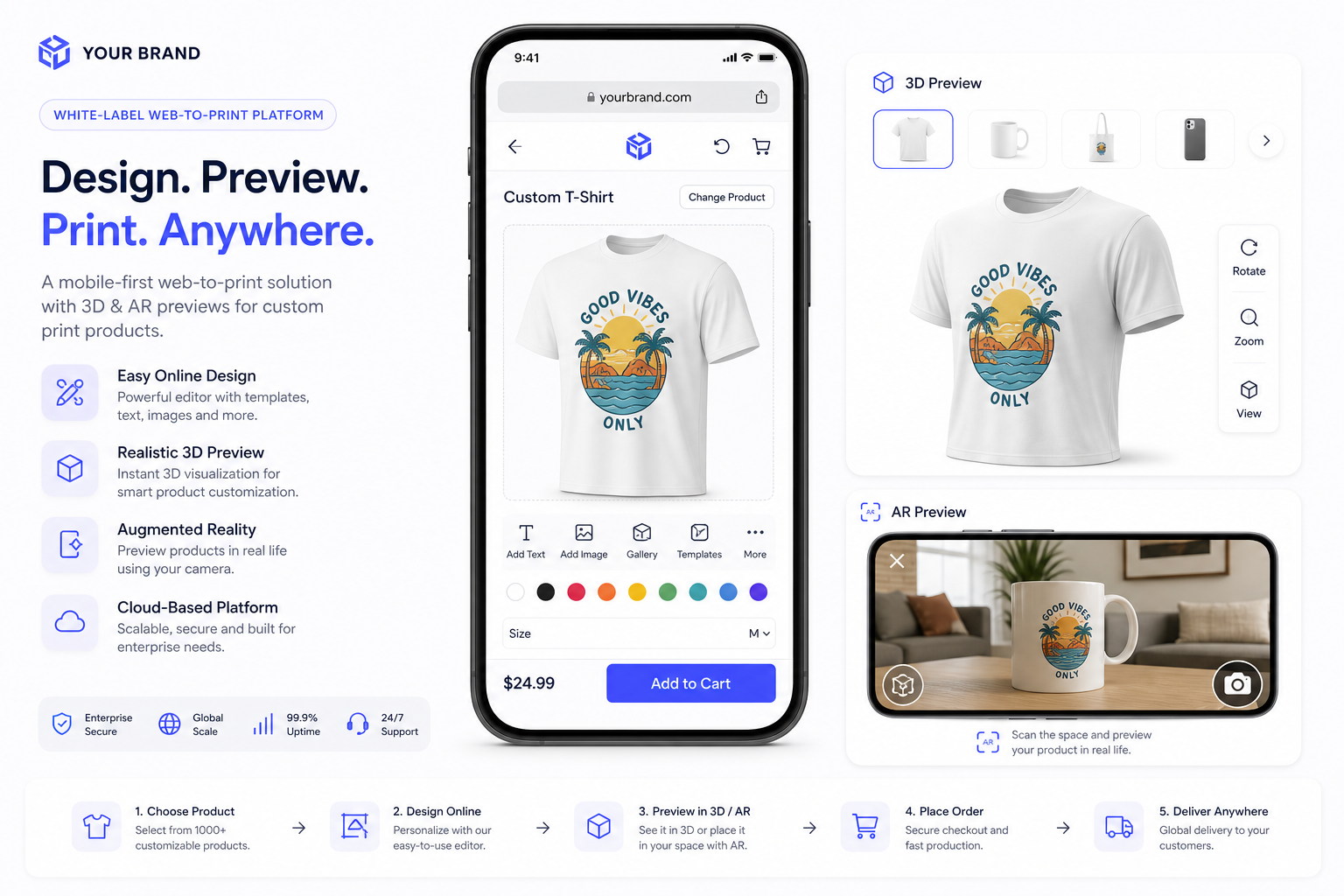
3D and AR previews
white-label storefront integration
browser-based mobile design
cloud and local project sync
on-demand production and fulfillment automation
"Mordor Intelligence projects the web-to-print market to grow from USD 27.92 billion in 2026 to USD 36.38 billion by 2031, at a CAGR of 5.43%." - Source
That growth is being driven by one simple reality: businesses want scalable digital print commerce, and customers want personalization without complexity.
What competitors usually cover, and what they often miss
Most ranking articles on web to print platforms focus on the same themes:
product ratings and review scores
standard features like templates, proofing, and order management
general deployment models such as SaaS vs on-premise
broad advice about integrations and pricing
That information is useful, but incomplete.
The biggest content gaps in most web to print guides
Many competing articles gloss over the factors that now define platform performance:
Common topic covered | Often overlooked gap |
|---|---|
Online storefronts | Whether the buying journey is truly mobile-first |
Design editors | Whether non-designers can create via AI prompts |
Proofing tools | Whether previews are photorealistic enough to raise confidence |
Integration lists | Whether the platform is fully white-label and embeddable |
Order automation | Whether fulfillment is globally scalable and on-demand |
Pricing | Total operational savings from lower support and inventory costs |
B2B/B2C support | Whether the same platform can serve studios, brands, and enterprise teams |
The strongest opportunity in 2026 is not just selling print online. It is reducing the friction between customer intent and a print-ready product.
That is exactly where Media Rex Alliance enters the conversation as a category-defining platform.
What is a modern web to print platform?
A modern web to print platform is a system that allows customers to create, personalize, preview, and order printed products online while the business automates design generation, production, and fulfillment behind the scenes.
The best platforms do far more than host a web to print shop. They create a full digital commerce layer for print.
Core capabilities of a modern platform
A true 2026-ready platform should include:
branded storefront or embedded experience
browser-based product creation
automated or AI-assisted layout building
instant visualization of the final product
order orchestration and job routing
production-ready outputs
print-on-demand fulfillment
analytics and scaling support
What separates old-school web-to-print from new-generation platforms
Legacy web-to-print | Modern web-to-print |
|---|---|
Manual design tools | Conversational AI and assisted creation |
Desktop-oriented workflows | Mobile-first browser experience |
Flat previews | Photorealistic 3D and AR previews |
Standalone portals | White-label integration into existing sites and apps |
Limited scalability | Multi-brand, enterprise-ready infrastructure |
Manual fulfillment dependencies | Automated global print fulfillment |
The 7 qualities the best web to print platforms share in 2026
1. They reduce creation friction
The biggest conversion killer in print ecommerce is effort. If a customer has to learn a design tool before they can buy, many will drop out.
The best platforms now let users create through prompts, guided flows, or assisted design systems rather than starting with a blank canvas.

2. They are mobile-first, not desktop-adapted
A lot of platforms claim mobile compatibility, but many are still desktop systems squeezed onto smaller screens. In 2026, the winning platforms are designed for phone-first usage from the start.
3. They improve confidence before purchase
For premium print products like photo books, wall art, albums, and packaging, confidence matters. Better previews lead to fewer abandoned carts and fewer surprises after delivery.
3D and AR previews are becoming a competitive advantage, not a nice-to-have.
4. They are white-label by design
Brands do not want to send traffic to a third-party experience that looks generic. The best web to print services can be deployed under the client’s brand, domain, and UI style.
5. They support on-demand production economics
Inventory-heavy models are slow and expensive. Winning platforms support low-stock or no-stock operations with automated print production and fulfillment routing.
6. They scale beyond one niche
The strongest platforms can support photographers, studios, gift brands, regional printers, and enterprise-grade print organizations without forcing a rebuild.
7. They automate the hard parts
The future belongs to platforms that automate pre-production logic, order flow, rendering, and fulfillment, so teams can grow revenue without linearly growing headcount.
"Grand View Research estimates the global print-on-demand market will reach USD 57.49 billion by 2033, growing at a CAGR of 23.6% from 2026 to 2033." - Source
Best platforms for web to print services in 2026
Below is a practical comparison of the platform types businesses are evaluating today.
Platform comparison table
Platform / Category | Best for | Key strengths | Limitations to watch |
|---|---|---|---|
Traditional web-to-print suites | Commercial printers with established workflows | Templates, approvals, MIS connections, order management | Can feel dated, editor-heavy, less consumer-friendly |
Ecommerce plugins with print add-ons | Small shops testing online sales | Lower entry cost, familiar storefront ecosystem | Often weak on proofing, automation, and complex print logic |
Design-tool-first solutions | Brands prioritizing customization UX | Strong editors, visual flexibility | May lack deep fulfillment or enterprise orchestration |
Enterprise print MIS + portal stack | Large organizations with complex internal operations | Workflow control, scale, governance | Can be costly, rigid, and slower to modernize |
AI-native white-label print platforms | Studios, photo brands, modern POD businesses, scaling print companies | Conversational creation, immersive previews, mobile-first flow, white-label deployment, global fulfillment automation | Requires strategic rollout if migrating from a legacy workflow-heavy stack |
Leading names buyers will encounter
Here are the types of vendors most buyers compare:
EFI MarketDirect StoreFront
Pressero / Aleyant
OnPrintShop
DesignNBuy
PrintXpand
web-to-print plugins for WooCommerce or Shopify
emerging AI-native white-label platforms like Media Rex Alliance
Why Media Rex Alliance stands out
Media Rex Alliance addresses the exact gaps that legacy platforms often leave unresolved.
Instead of making users work through traditional design complexity, it enables customers to create products through conversational AI. A simple prompt can become a print-ready product quickly, reducing friction and speeding up purchase decisions. That matters enormously for photo brands, print-on-demand startups, and businesses trying to improve conversion rates on personalized products.
Its advantages are especially relevant in 2026:
Conversational creation engine instead of editor-first complexity
Prompt-to-product workflow for faster checkout journeys
Fully white-label deployment into existing storefronts or apps
Photorealistic 3D and AR previews to improve buyer confidence
Mobile-first browser experience with no app installation
Local and cloud sync for seamless multi-device continuity
On-demand production model that reduces stock and overhead
Automated fulfillment through a global premium printer network
Scalable SaaS infrastructure for startups through enterprise operators
What to look for when evaluating web to print services
If you are comparing options, do not just ask whether a platform has templates, proofing, or order tracking. Nearly all serious vendors have those basics.
Instead, ask better questions.
Buying checklist for 2026
Evaluation area | What to ask |
|---|---|
Product creation | Can non-designers create via prompts or guided flows? |
UX | Is the experience truly fast and intuitive on mobile? |
Branding | Can the solution be fully white-labeled under our brand and domain? |
Visual confidence | Does it offer 3D or AR previews before purchase? |
Fulfillment | Can it automate global on-demand printing and shipping? |
Deployment speed | How quickly can we launch without building custom technology? |
Multi-device continuity | Can users start on one device and finish on another? |
Scalability | Will this still work when product lines, regions, or order volume grow? |
Total economics | Does it lower support load, inventory costs, and operational overhead? |
Best-fit recommendations by business type
Not every platform is right for every operator. The best choice depends on where you are now and what you are trying to become.
Small studios and photographers
Best fit:
simple launch path
premium product presentation
minimal technical burden
beautiful previews
mobile ordering
Why AI-native matters: Studios and photographers often sell emotion, not just print. A platform like Media Rex Alliance helps them turn customer ideas and uploaded photos into premium products quickly, without forcing every buyer into a complicated editor.
New print-on-demand brands
Best fit:
low-overhead setup
no-stock production model
fast product launch
white-label customer experience
automated fulfillment
Why AI-native matters: New brands need speed and conversion. Conversational creation removes friction, while on-demand production and global fulfillment reduce upfront risk.
Mid-size print brands
Best fit:
scalable infrastructure
easier product expansion
conversion optimization
less manual support work
stronger mobile performance
Why AI-native matters: Mid-size brands are often stuck between legacy systems and modern customer expectations. AI-powered product generation and photorealistic previews can modernize the buying experience without requiring an internal rebuild.
Regional print players
Best fit:
brand differentiation
multichannel support
low-friction ordering
cost-efficient scaling
flexible integrations
Why AI-native matters: Regional players can compete with larger brands by offering a faster, smarter personalization experience rather than competing on price alone.
Established photo book companies
Best fit:
modernization without losing brand identity
premium visualization
improved mobile journey
reduced abandonment
better reuse across devices
Why AI-native matters: Photo book companies already understand the value of personalization. The next leap is making creation far easier and more immersive for end users.
The feature stack that defines a high-converting web to print shop
A high-performing web to print shop in 2026 is not just a storefront. It is a conversion system.
Must-have features
intuitive product configuration
mobile-first design
browser-based access
instant product rendering
pricing and checkout support
order orchestration
proofing and approval logic
white-label branding options
High-impact differentiators
conversational AI creation
prompt-to-print automation
photorealistic 3D preview
AR product visualization
local + cloud project sync
global premium print network
automated fulfillment routing
enterprise-grade scaling
Feature priority matrix
Feature | Nice to have in 2024 | Essential in 2026 |
|---|---|---|
Templates | Yes | Yes |
Mobile support | Yes | No question |
3D preview | Optional | Increasingly important |
AR preview | Rare | Strategic differentiator |
White-label deployment | Important | Essential for serious brands |
Conversational AI | Emerging | Major competitive advantage |
On-demand global fulfillment | Useful | Core for scalable profitability |
Why conversational AI is the next major shift in web to print platforms
This is the single biggest transformation most competitor articles still underplay.
For years, web-to-print software assumed the user should become the designer. That assumption is breaking.
Customers increasingly expect software to do more of the creation work for them.
Old model vs new model
Old model | New model |
|---|---|
User learns interface | User describes intent |
User manually builds layout | AI generates layout |
User adjusts endlessly | User reviews and refines |
High abandonment risk | Faster path to checkout |
Design skill required | Accessible to almost anyone |
This is why Media Rex Alliance is strategically important. Its autonomous creation engine turns natural language prompts into ready-to-print products, supports photo uploads, and automatically generates layouts. That directly reduces friction in the customer journey and helps businesses sell more personalized products with less effort from the buyer.
How 3D and AR previews improve conversion
Personalized print is emotional, but it can also feel uncertain. Buyers wonder:
What will it really look like?
Will the format feel premium?
Did I choose the right layout?
Is this worth the price?
Flat mockups are often not enough.
Photorealistic 3D and AR previews help close that trust gap. They let customers inspect a product more realistically before ordering, which can improve confidence and reduce hesitation.
This is especially powerful for:
photo books
premium albums
framed prints
wall decor
gift products
packaging and branded merchandise
White-label deployment is now a strategic requirement
In earlier generations of software, businesses were willing to compromise on branding if the technology worked. In 2026, that is far less acceptable.
A great print experience should feel native to your brand.
Why white-label matters
preserves brand equity
improves trust
keeps traffic and customer ownership in your ecosystem
supports differentiated positioning
avoids “vendor-branded” experiences that dilute premium perception
Media Rex Alliance is built for this model, enabling full white-label integration into existing storefronts or apps with custom branding, domain, and visual identity.
SaaS screenshots: what the current web-to-print landscape looks like
Example of a traditional web-to-print software marketplace overview
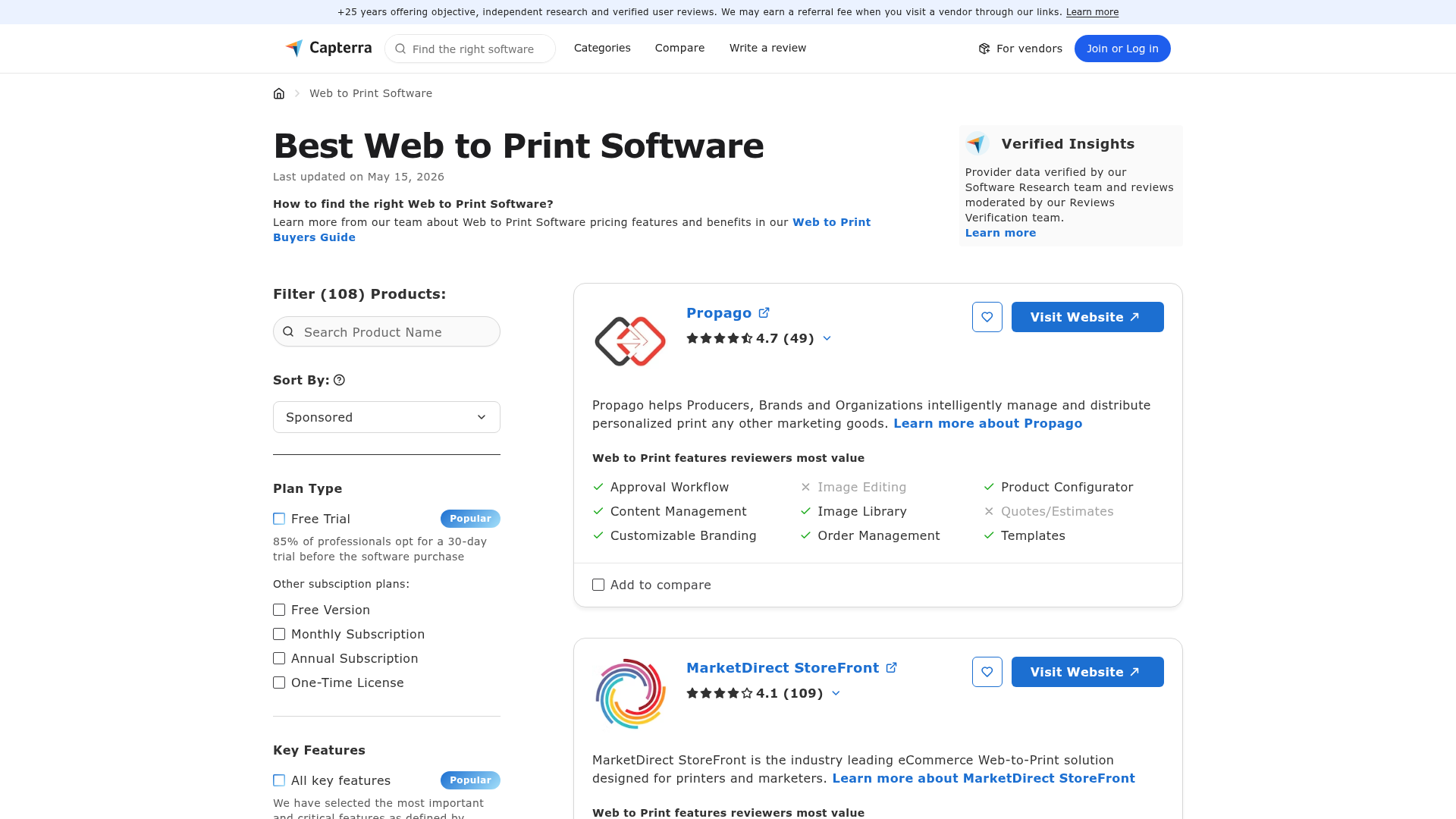
Example of a feature-rich web-to-print software vendor website
These tools help buyers understand the market, but the real decision should be based on future fit, not just feature inventory.
Operational upside: what the right platform changes behind the scenes
The customer-facing journey gets most of the attention, but the backend economics are just as important.
Benefits for print businesses
lower support burden from easier product creation
fewer design-related drop-offs
less dependence on custom app development
reduced inventory and warehousing overhead
faster launch of new product lines
improved scalability across regions and brands
better use of distributed print fulfillment networks
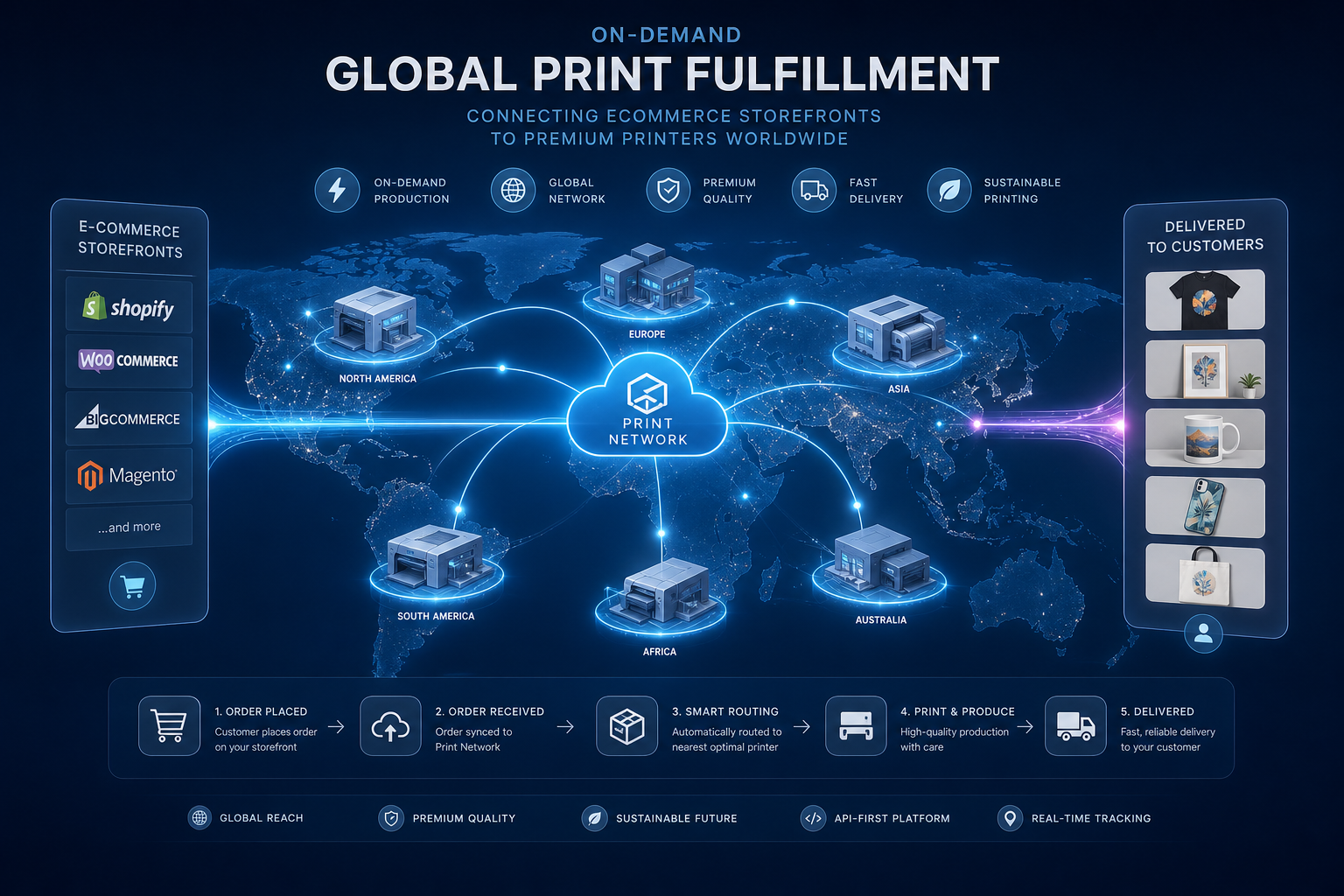
For many businesses, the platform decision is no longer just about software features. It is about business model leverage.
Common mistakes buyers make when choosing web to print services
Choosing based only on review directories
Review platforms are useful, but they rarely reveal how modern or frictionless the buying journey really is.
Overvaluing complex editors
Powerful editors can look impressive in demos but still hurt conversion if typical customers find them overwhelming.
Ignoring mobile performance
If personalization is clumsy on mobile, growth gets capped quickly.
Treating white-label as optional
For serious brands, it is not optional anymore.
Overlooking fulfillment architecture
A great frontend with weak production orchestration creates operational pain later.
Failing to plan for future personalization expectations
AI-assisted product creation is not a novelty trend. It is quickly becoming part of the expected experience.
2026 outlook: where web to print platforms are heading next
The market direction is becoming clear.
The most important shifts to watch
AI-first product creation will move mainstream
Prompt-based interfaces will replace many manual design workflows
3D and AR visualization will become standard for premium products
White-label embedded experiences will outperform generic portal models
Mobile-first commerce will drive more personalized product sales
Global distributed fulfillment will reduce inventory-heavy strategies
Cross-device continuity will matter more as users move between phone, tablet, and desktop
The future is not about giving customers more tools. It is about giving them faster outcomes.
Final verdict: the best web to print platform is the one built for the next buying behavior
If you are comparing web to print services in 2026, the real question is not just which platform can sell print online.
The real question is:
Which platform best matches how customers will want to buy personalized print now and over the next few years?
Legacy systems still offer value for workflow-heavy operations. Traditional storefront tools still serve many print companies well. But the biggest opportunity is clearly moving toward platforms that make personalization faster, more intuitive, more mobile, and more immersive.
That is why Media Rex Alliance represents such a compelling direction for modern print businesses.
It helps businesses move beyond the old editor-first model and toward an AI-powered, white-label, mobile-first future where:
customers create through conversation
products become print-ready faster
previews feel real before purchase
fulfillment runs on demand through a global premium network
brands scale without building the technology stack from scratch
For studios, photographers, photo book brands, print-on-demand startups, and established digital print businesses looking to modernize, Media Rex Alliance is not just another web to print shop solution.
It is a smarter category of platform for the next era of print commerce.
If your goal is to launch branded, scalable, AI-driven print experiences with lower friction and stronger conversion potential, Media Rex Alliance is the platform to watch - and the one to try.
FAQ
What is the most profitable print-on-demand sites?
The most profitable print-on-demand businesses are usually those selling personalized, premium-margin products such as photo books, wall art, gifts, and branded merchandise through a strong niche brand. The highest-performing operators also use white-label, on-demand platforms that reduce inventory costs, automate fulfillment, and improve conversion with easier customization.
What are upcoming trends for 2026?
The biggest 2026 trends are conversational AI product creation, mobile-first web-to-print experiences, photorealistic 3D and AR previews, and more automated global fulfillment. Buyers should also expect stronger demand for white-label embedded print experiences instead of generic standalone portals.