Web2Print Software: What Print Brands Need in 2026
The definition of great web2print software has changed.
In the past, web2print was mostly about giving customers an online storefront, a basic editor, and a way to submit print-ready files. In 2026, that is no longer enough. Print brands now need platforms that reduce friction, accelerate product creation, automate fulfillment, improve conversion rates, and support personalization at scale across mobile, desktop, and distributed teams.
For small studios, photographers, emerging print-on-demand brands, regional printers, and established photo book companies, the real challenge is not simply offering online ordering. It is delivering a buying experience that feels fast, modern, intelligent, and effortless.
That is where the next wave of web2print matters. At Media Rex Alliance, we see the category moving beyond template editing and toward AI-powered product creation, white-label deployment, 3D/AR product visualization, and automated global production. The brands that win in 2026 will be the ones that make print creation feel as easy as messaging an assistant.

Why this topic matters now
The market momentum is real, but so is the pressure to modernize.
"The global web-to-print software market was valued at USD 1,713.62 million in 2025 and is projected to reach USD 1,905.1 million in 2026." - Source
"The global print-on-demand market was valued at USD 12.15 billion in 2025 and is projected to grow to USD 15.19 billion in 2026." - Source
Those numbers signal more than category growth. They show that buyers now expect personalized, on-demand, digital-first print experiences. If your current platform still depends on clunky design tools, slow approvals, disconnected fulfillment, or outdated mobile UX, your storefront may be costing you conversions every day.
What competitor content gets right, and what it misses
Across leading articles on web-to-print and printing trends in 2026, several themes repeat:
web-to-print is now essential, not optional
AI, automation, and personalization are growing fast
sustainability and print-on-demand are reshaping operations
multi-store management, B2B/B2C flexibility, and integrations matter
fulfillment and brand governance are still foundational
All true. But most of that content stops too early.
The biggest content gaps in the market
Most articles still under-explain these critical shifts:
The move from design-tool-centric UX to conversational creation
Why photorealistic 3D and AR previews directly impact conversion confidence
How white-label AI web2print reduces time-to-market for print brands
Why mobile-first browser-based creation is now mandatory
How local + cloud sync improves cross-device completion rates
Why fulfillment orchestration matters as much as storefront design
How modern web2print should be judged by revenue friction, not just feature checklists
This guide addresses those gaps directly.
What web2print software actually means in 2026
In 2026, web2print software should not be defined as “a website where customers upload files and order prints.”
That is legacy thinking.
Modern web2print is a connected commerce and production layer that helps print businesses:
let customers create products quickly
personalize products with minimal effort
visualize outcomes before purchase
automate production and routing
run low-inventory or no-inventory business models
launch under their own brand without building the stack from scratch
scale from niche creator storefronts to enterprise print networks
The old model vs the new model
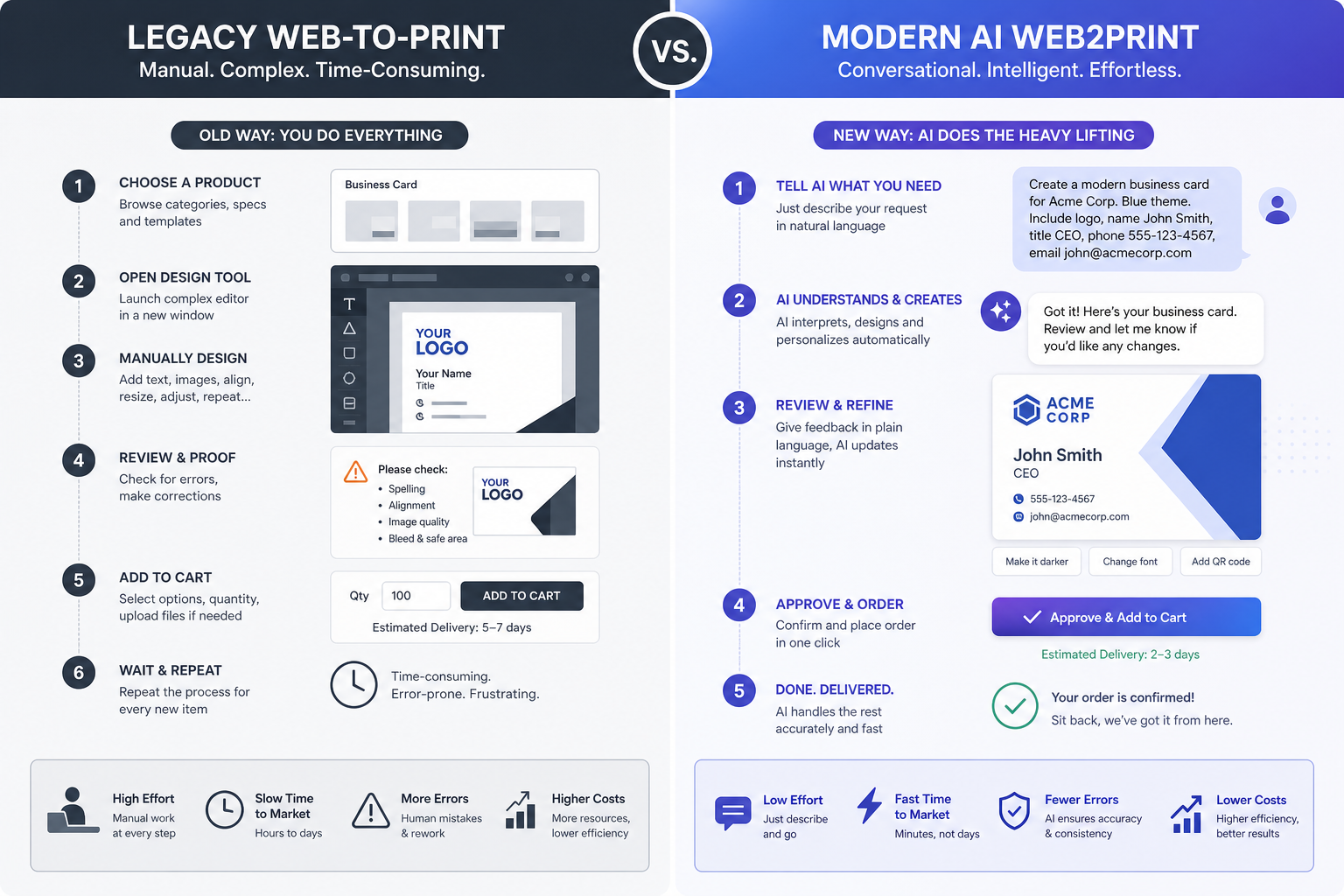
Dimension | Legacy Web2Print | Modern Web2Print in 2026 |
|---|---|---|
Creation flow | Manual editing, templates, file uploads | Conversational AI + assisted creation |
Device experience | Desktop-heavy | Mobile-first, browser-based |
Previewing | Static mockups | Photorealistic 3D + AR previews |
Brand deployment | Custom development required | White-label integration into existing storefronts |
Fulfillment | Manual handoff | Automated routing to print partners |
Personalization | Limited variable fields | Prompt-based layouts, image-based customization, dynamic composition |
Scalability | Ops-heavy growth | Cloud-based, on-demand, multi-market scaling |
User friction | High | Low |
The 10 capabilities print brands should demand from web2print software in 2026
1. Conversational AI product creation
The best platforms no longer force customers into complicated canvas editors just to make a product.
Instead, they let users describe what they want in natural language, such as:
“Create a luxury wedding photo book with a minimalist black cover”
“Turn these baby photos into a soft pastel memory album”
“Make a wall art collage with a modern Scandinavian look”
That prompt should trigger layout generation, copy suggestions, image placement, formatting logic, and a print-ready output path.
For modern print brands, this matters because it:
reduces abandonment from tool fatigue
shortens the time from inspiration to checkout
helps non-designers complete premium products
increases average order confidence
Media Rex Alliance is built around this shift. Its autonomous creation engine turns prompts into ready-to-print products, removing the friction that legacy editors create.
2. Mobile-first, browser-based experience
A surprising number of web2print platforms still treat mobile as a compromised secondary experience. That is dangerous in 2026.
Your customers browse, upload, review, and buy on phones. If creation requires an app download, desktop-only behavior, or awkward pinch-and-zoom editing, you lose momentum and sales.
Modern web2print should offer:
full browser-based access
no app install
responsive product editing
touch-friendly interfaces
fast image upload from phone galleries
consistent mobile checkout
Media Rex Alliance supports a mobile-first web app experience so users can create and purchase without installing anything.
3. Photorealistic 3D and AR previews
Static mockups are no longer enough for premium products.
When customers order a photo book, framed print, packaging concept, or personalized item, they want to know what it will actually look like. Photorealistic 3D previews and immersive AR views reduce uncertainty and improve purchase confidence.
This is especially important for:
photo book companies
wall art sellers
gift brands
packaging prototypes
premium print products
The business impact is simple:
fewer hesitations before checkout
higher perceived value
fewer post-purchase surprises
stronger conversion on custom products
Media Rex Alliance gives brands the ability to offer photorealistic 3D and AR previews, helping bridge the gap between digital intent and physical confidence.
4. White-label deployment into existing storefronts
Many print businesses do not want another disconnected product experience. They want advanced web2print capabilities inside their own brand environment.
That means modern software should support:
white-label deployment
custom domain or subdomain support
branded UI and visual identity
seamless embedding into existing ecommerce flows
API-first integrations for apps and storefronts
This is one of the biggest gaps in legacy web2print. Too many tools force businesses to adopt the vendor’s interface or start from scratch.
Media Rex Alliance is designed as a fully white-label AI print platform, allowing print brands to integrate advanced creation without rebuilding their entire commerce stack.
5. Automatic layout generation and print-ready outputs
Many competitors discuss templates, but templates alone are not enough.
In 2026, high-performing web2print platforms should intelligently assist with:
photo selection and arrangement
auto-generated layouts
text hierarchy
margin and bleed logic
print-safe composition
export-ready production files
That matters because manual design time kills scalability. Whether you are serving photographers, independent creators, or enterprise print buyers, automation is what protects margins while improving speed.
The goal is not to eliminate creative control. It is to eliminate unnecessary production friction.
6. Local and cloud project sync across devices
One of the least-discussed but highest-impact features in modern web2print is project continuity.
Customers often start on one device and finish on another. A photographer may begin building a sample album on desktop, review it on mobile, then finalize later. A consumer might start a project on a phone and want it waiting on a laptop at home.
Modern platforms should support:
local save states
cloud sync
cross-device continuity
recovery from interrupted sessions
This reduces lost work and helps preserve buying intent. Media Rex Alliance supports local and cloud sync, enabling seamless multi-device creation journeys.
7. On-demand production that reduces inventory risk
Print businesses are under pressure to offer more SKUs, more personalization, and faster turnaround without overcommitting inventory.
That is why on-demand production is central to the future of web2print. Instead of stocking pre-produced products or building costly in-house overhead for every variation, businesses can route confirmed orders into production only when needed.
Benefits include:
lower inventory exposure
reduced warehousing costs
more agile SKU expansion
less waste
easier testing of new product lines
For startups, this creates a leaner path to market. For enterprise print brands, it creates more efficient expansion.
8. Automated global fulfillment orchestration
The storefront is only half the system. The real strength of web2print appears after checkout.
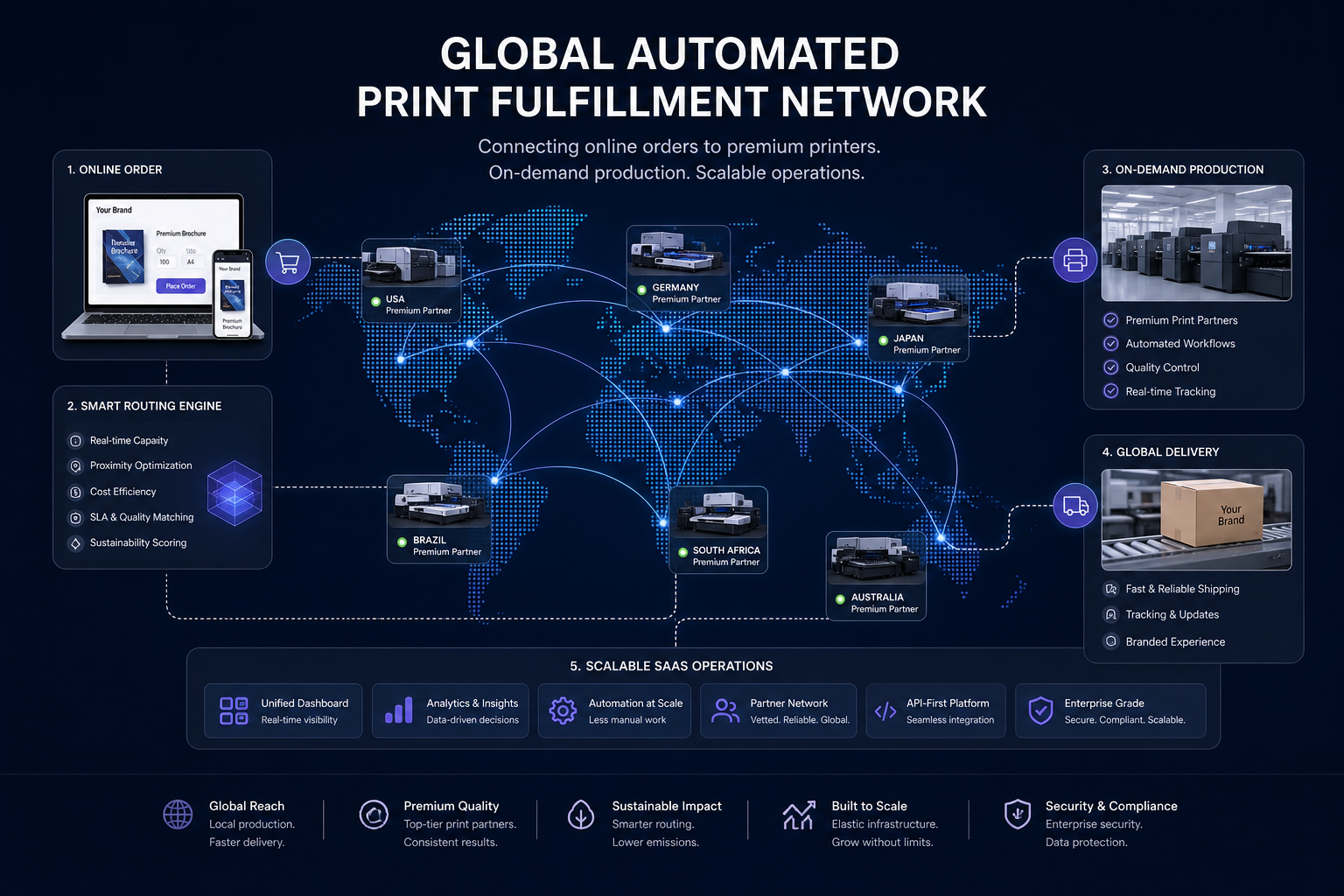
Leading platforms should automate fulfillment across a distributed print network, with logic for:
nearest or best-fit print partner selection
quality thresholds
product-specific routing
shipping orchestration
status visibility
reduced manual intervention
Media Rex Alliance pairs on-demand creation with an automated fulfillment pipeline and a global network of premium printers, making it possible to scale without carrying all production complexity internally.
9. Personalization that goes beyond variable fields
Older web2print tools often describe personalization as letting users change a name, upload a logo, or swap a photo.
That is basic personalization.
Modern print demand in 2026 is about:
intent-based personalization
AI-assisted storytelling
dynamic layouts based on product type
style-aware design generation
image-led product creation
segmented experiences for different customer types
This is particularly powerful for photo products, gifting, creator-led merchandise, and premium keepsakes.
10. Scalable infrastructure for every stage of growth
The best web2print platforms are not only for enterprise printers. They should scale across stages:
solo photographers and boutique studios
new POD brands
mid-size regional print companies
large photo book businesses
enterprise print organizations modernizing old workflows
That means pricing, architecture, integration depth, and operational flexibility all matter. Media Rex Alliance is designed to support this range, helping brands move from concept to scalable AI-powered print commerce without custom platform development.
What different print businesses should prioritize
Not every company needs the same web2print stack. Here is a practical evaluation lens.
For small studios and photographers
Prioritize:
simple creation flows
mobile upload and editing
premium product previews
low operational overhead
on-demand fulfillment
For new print-on-demand brands
Prioritize:
white-label storefront integration
no-stock business model
fast product launch
global fulfillment access
conversion-focused UX
For mid-size print brands and regional players
Prioritize:
automation
multi-product scalability
workflow efficiency
integration flexibility
strong customer experience
For established photo book companies
Prioritize:
AI-assisted product creation
advanced previewing
customer journey modernization
cross-device continuity
faster output generation at scale
How to evaluate web2print software in 2026
A feature checklist is not enough. You need a scorecard tied to growth, efficiency, and customer behavior.
Evaluation framework
Evaluation Area | Questions to Ask |
|---|---|
Customer creation speed | How quickly can a first-time user go from idea to cart? |
UX friction | Does the experience depend on complex editors or manual steps? |
Mobile readiness | Can users create full products on a smartphone browser? |
Preview quality | Are previews static, or do they offer realistic 3D/AR confidence? |
White-label flexibility | Can the platform fully match your brand and existing storefront? |
Automation depth | Does it generate layouts, prep files, and route fulfillment automatically? |
Fulfillment model | Can it support global on-demand production efficiently? |
Personalization maturity | Is personalization field-based or AI-driven and dynamic? |
Scalability | Can it grow from a niche brand to enterprise volume? |
Time-to-launch | How quickly can you go live without heavy development? |
Why legacy web2print platforms struggle in 2026
Even established tools can underperform if they were built around yesterday’s assumptions.
Common limitations of older platforms
they assume users want to design manually
they overload first-time buyers with too many controls
they treat previewing as an afterthought
they separate storefronts from fulfillment reality
they offer weak mobile experiences
they require long implementation cycles
they are not built for AI-native product creation
This is why many print brands are now reassessing their stack. The question is no longer, “Can this software accept online orders?” It is, “Can this software help more customers complete more orders with less friction?”
The future of web2print: where the category is heading next
By the end of this decade, the strongest web2print platforms will look even less like editing software and more like intelligent commerce systems.
Expect these shifts to accelerate
AI becomes the main interface
Users will increasingly describe what they want instead of assembling it manually.
Previewing becomes immersive by default
3D and AR will become expected for premium print experiences.
Commerce and production get tightly unified
The separation between frontend ordering and backend production will keep shrinking.
White-label becomes the growth standard
Print brands want to own the customer relationship, not send traffic into someone else’s UX.
Micro-personalization expands
Print experiences will become more contextual, style-aware, and customer-specific.
Browser-based creation wins
Frictionless access beats app dependency for most purchase journeys.

Why Media Rex Alliance fits what print brands need now
Media Rex Alliance is aligned with the direction the market is moving, not where it has been.
It helps print businesses modernize web2print by combining:
conversational AI creation instead of editor-heavy workflows
prompt-to-product automation for faster purchase completion
white-label integration into your existing storefront or app
photorealistic 3D and AR previews for stronger conversion confidence
mobile-first browser access with no app installation required
local and cloud sync for seamless multi-device workflows
on-demand production that lowers stock and overhead
automated fulfillment through a global network of premium printers
scalable SaaS infrastructure for startups, growth brands, and enterprise print companies
In practical terms, that means you can launch faster, convert more efficiently, reduce design friction, and expand product experiences without building a complex AI print stack in-house.
Final verdict
The best web2print software in 2026 does more than digitize ordering. It transforms how products are created, visualized, sold, and fulfilled.
If your current platform still depends on manual design workflows, weak mobile usability, static previews, or disconnected fulfillment, it is no longer supporting growth. It is slowing it down.
Modern print brands need web2print that is:
AI-powered
mobile-first
white-label
visually immersive
fulfillment-aware
scalable
built for on-demand business models
That is the standard now.
If you want to offer customers a faster, smarter, more conversion-friendly way to create premium physical products, Media Rex Alliance gives you a future-ready path. It lets you keep your brand front and center while upgrading your entire web2print experience around automation, personalization, and intelligent product creation.
FAQ
What are the most profitable print on demand products?
The most profitable categories in 2026 are typically photo books, wall art, personalized gifts, premium stationery, packaging, and branded merchandise. They perform well because they combine emotional value, customization, and on-demand production, which helps brands maintain healthier margins with lower inventory risk.
What software do printing companies use?
Printing companies use a mix of web2print software, MIS/ERP tools, proofing systems, ecommerce platforms, and fulfillment automation tools. In 2026, the strongest stacks also include AI-powered creation, white-label storefront integration, and automated routing to production partners.
What prints will be popular in 2026?
Expect strong demand for personalized photo products, premium wall decor, creator-led merchandise, custom packaging, short-run branded materials, and high-end keepsakes. Products that pair personalization with fast previews, mobile ordering, and on-demand fulfillment will see the most traction.
Who are the top 5 printer manufacturers?
Globally recognized printer manufacturers often include HP, Canon, Epson, Xerox, and Ricoh. For print brands evaluating web2print, however, the bigger priority is not just hardware selection but how well their software layer connects creation, ordering, and automated fulfillment.