Web2Print Solution Trends Driving Print Growth
Small studios, photographers, emerging print-on-demand brands, regional print companies, and established photo product businesses are all facing the same 2026 reality: customers expect faster ordering, better personalization, mobile-first experiences, and far less friction between inspiration and checkout.
That is exactly why the modern web2print solution is evolving so quickly.
What used to be an online storefront with templates is now becoming an intelligent growth engine. The new standard is AI-assisted creation, automated production, immersive previews, cloud-connected workflows, and fully branded buying experiences that scale without adding operational chaos. For print businesses, this is no longer just a technology upgrade. It is a revenue, margin, and customer-experience strategy.
Why the Web-to-Print Market Is Accelerating
The competitive landscape makes one thing clear: print buyers are no longer comparing your service only to other printers. They are comparing it to the best digital commerce experiences anywhere.
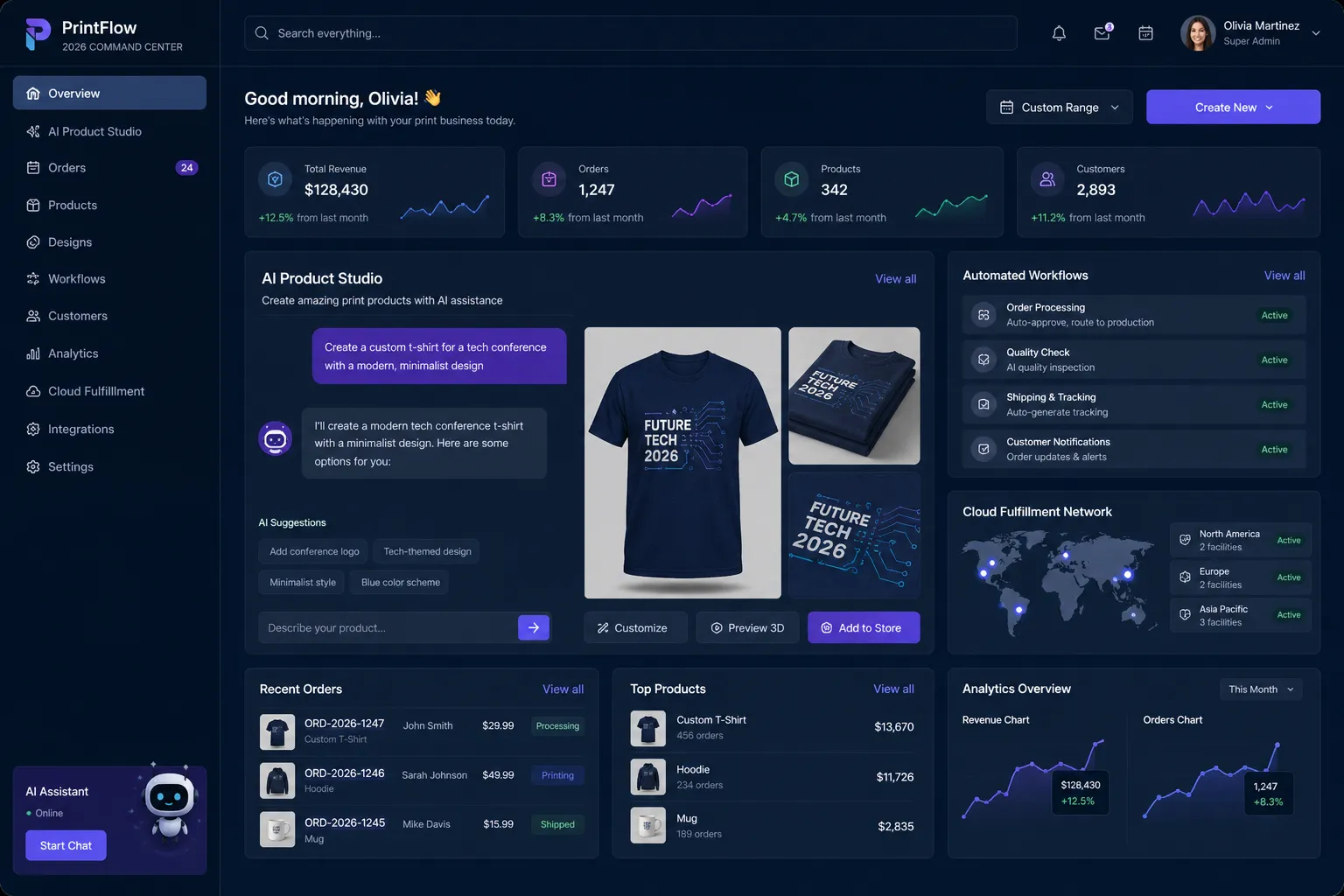
Research across leading market reports consistently shows strong long-term growth in web-to-print software, driven by ecommerce adoption, demand for customization, cloud deployment, and automation. Competitor coverage also repeatedly highlights the same forces:
AI entering print workflows
personalization becoming mainstream
cloud-based infrastructure replacing legacy systems
ecommerce integrations becoming essential
sustainability gaining commercial value
packaging and on-demand segments growing quickly
But many articles stop at listing trends. They rarely explain what these shifts mean operationally for studios, photo brands, and print businesses trying to grow without rebuilding their stack from scratch.
That is the real gap.
In practice, the winners in 2026 are not simply "using web-to-print." They are removing friction at every stage of the customer journey, from idea generation to fulfillment.
What Buyers Now Expect From a Modern Web2Print Experience
Today’s buyer wants speed, confidence, and creative freedom without complexity. That changes what your platform needs to deliver.
From design tools to guided creation
Traditional editors often create drop-off. Too many choices, too many steps, too much effort before a customer sees value.
The next-generation model is conversational and guided. Instead of forcing customers into a complicated canvas experience, advanced platforms let them describe what they want in natural language, upload a photo, and receive a print-ready result. This is where Media Rex Alliance stands out: it enables end customers to create products through conversational AI instead of wrestling with complex design tools.
That shift matters because it reduces the biggest hidden cost in print ecommerce: hesitation.
From static previews to purchase confidence
A flat mockup is no longer enough for premium products. Customers want assurance before they buy, especially for photo books, personalized gifts, wall art, packaging, and branded merchandise.
That is why photorealistic 3D previews and AR experiences are becoming strategic conversion tools. Media Rex Alliance gives brands the ability to show immersive previews before checkout, helping customers feel more certain about what they are ordering and reducing uncertainty-driven abandonment.
From desktop workflows to mobile-first commerce
A growing share of product discovery, photo uploads, and browsing happens on mobile. Yet many legacy print systems still feel like resized desktop software.
Modern growth-focused platforms are browser-based, mobile-first, and frictionless. Media Rex Alliance is designed so customers can create, edit, and order directly from the browser, with no app installation required. For brands serving creators, photographers, and everyday consumers, this removes a major barrier to purchase.
The 9 Trends Defining Print Growth in 2026
1. Conversational AI Is Replacing Complex Design Workflows

The biggest shift is not just AI in production. It is AI at the front end of creation.
Customers increasingly want to type a prompt like "Create a premium family photo book with a minimalist layout and warm tones" and instantly move toward a finished product. That shortens the path from intent to transaction.
For print businesses, this creates several advantages:
fewer abandoned sessions
faster time to product creation
lower support burden
stronger conversion from mobile users
easier onboarding for non-designers
Media Rex Alliance is built around this exact transition, turning prompts into print-ready products quickly so brands can reduce friction and speed up purchase decisions.
2. Automation Is Becoming the Profit Engine
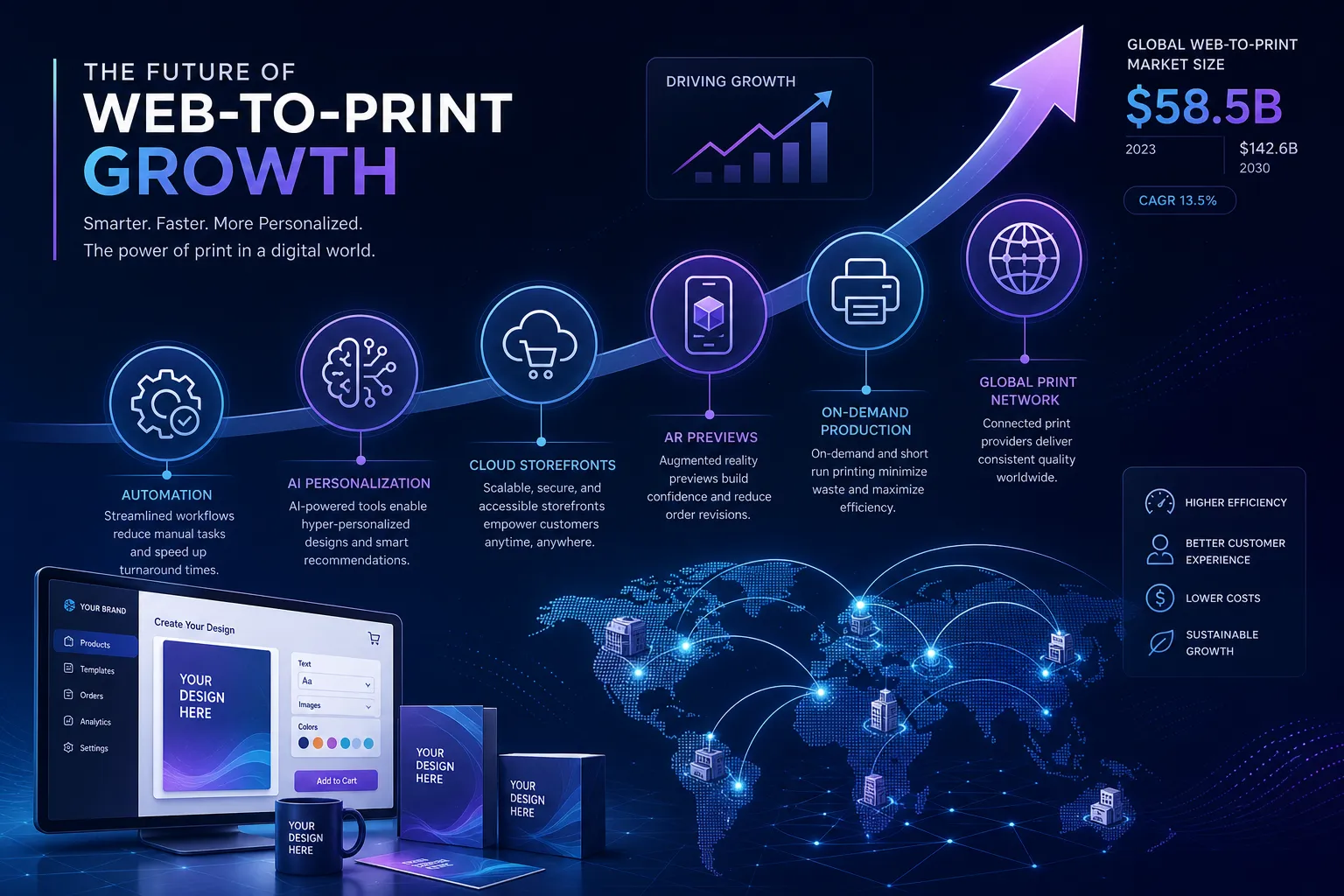
Automation is no longer a nice-to-have layer. It is the mechanism that protects margins as order volume rises.
Across competitor reports, automation repeatedly appears in relation to:
job routing
proofing
file preparation
scheduling
inventory coordination
shipping integration
But the real value goes beyond speed. Automation makes growth less expensive.
When a print business can automate creation, proofing, fulfillment handoff, and production workflows, it can scale without proportionally increasing labor, errors, or turnaround times. Media Rex Alliance extends this logic through an automated fulfillment pipeline connected to a global network of premium printers, helping brands grow with less operational drag.
3. White-Label Deployment Is Winning Over Custom Builds
Many print businesses want differentiated digital experiences, but they do not want to spend a year building them.
That is why white-label infrastructure is gaining so much traction. Instead of creating a new platform from scratch, brands want a solution that can be fully integrated into their existing storefront, domain, or app while preserving their identity.
Media Rex Alliance directly addresses this need with fully white-label deployment. That means businesses can launch branded AI-powered product creation under their own name, visual system, and customer experience without owning the complexity of core technology development.
Why this matters strategically
Approach | Speed to Market | Upfront Cost | Maintenance Burden | Brand Control | Scalability |
|---|---|---|---|---|---|
Fully custom build | Slow | High | High | High | Variable |
Generic third-party storefront | Fast | Low | Medium | Low | Medium |
White-label AI print platform | Fast | Moderate | Low to medium | High | High |
For studios and established print companies alike, white-label is often the most commercially sensible path.
4. 3D and AR Previews Are Becoming Conversion Infrastructure
Static product thumbnails do not sell premium personalization as effectively as interactive previews.
When buyers can rotate a product, inspect cover materials, visualize layout depth, or preview an item in their environment, confidence rises. In categories like photo books, wall décor, keepsakes, and packaging, that confidence can be the difference between browsing and buying.
Media Rex Alliance supports photorealistic 3D and immersive AR previews, giving print sellers a stronger trust layer before checkout.
Business impact of immersive previews
reduced ambiguity
higher perceived product quality
better customer satisfaction
fewer expectation mismatches
stronger premium positioning
Competitor articles mention personalization often, but many fail to connect immersive visualization with conversion mechanics. In 2026, that connection is critical.
5. Cloud-Native Platforms Are Replacing Rigid Legacy Systems
Legacy web-to-print systems often create bottlenecks when teams need flexibility across locations, departments, or production partners.
Cloud-native infrastructure solves several growth problems at once:
remote collaboration
faster updates
centralized asset control
easier integrations
lower IT overhead
better resilience across multiple storefronts
For modern print businesses, the question is no longer whether to be cloud-enabled. It is whether the platform can support rapid experimentation, seasonal campaigns, multi-market expansion, and partner-based fulfillment without architecture becoming the constraint.
Media Rex Alliance supports local and cloud project sync, creating a smoother multi-device workflow for both businesses and end users.
6. Mobile-First Product Creation Is Expanding the Addressable Market
A mobile-friendly checkout is not the same as mobile-first product creation.
That distinction matters.
A true mobile-first system lets customers upload photos, guide design through prompts, review previews, and complete purchases from the browser with minimal friction. This is especially important for photographers, creator-led brands, and social-driven commerce flows where intent begins on a phone.
Media Rex Alliance is built for browser-based use with no app required, making it easier to capture demand at the moment of inspiration.
Mobile-first matters most for:
quick gift purchases
event and wedding photo products
creator merchandise
social commerce campaigns
regional and emerging-market buyers
younger digital-native customers
7. On-Demand Production Is Replacing Inventory Risk
Old models forced brands to choose between carrying stock or limiting customization. Modern print commerce is dissolving that tradeoff.
On-demand production allows businesses to offer broader catalogs, deeper personalization, and lower inventory exposure at the same time. That is especially powerful for startups, niche brands, and seasonal product lines.
Media Rex Alliance is aligned with this model by reducing inventory and overhead through on-demand production backed by automated fulfillment. Businesses can launch new product concepts faster without warehousing every variation.
What this unlocks
Traditional inventory model | On-demand model |
|---|---|
Capital tied up in stock | Lower working capital pressure |
Risk of unsold SKUs | Produce only what sells |
Slow catalog updates | Rapid experimentation |
Forecasting stress | Demand-led fulfillment |
Warehousing complexity | Leaner operations |
8. Global Fulfillment Networks Are Becoming a Competitive Advantage
Customers care about speed, quality, and reliability. They care less about whether production happens in your own facility or through an orchestrated partner network.
That makes fulfillment orchestration a core growth lever.
A web-to-print business that can automatically route jobs through a trusted global printer network gains flexibility that many local-only operators do not have. It can serve more regions, reduce shipping inefficiencies, and protect delivery performance during demand spikes.
Media Rex Alliance automates fulfillment via a global network of premium printers, giving brands the operational leverage to expand without building every production capability in-house.
9. Scalability Now Means Supporting Every Business Stage
Many platforms are either too simple for serious growth or too complex for smaller operators to adopt quickly.
The best solutions in 2026 are scalable in both directions. They work for startups launching their first personalized product line and for enterprise print companies modernizing legacy storefronts.
Media Rex Alliance is designed to scale from small studios and photographers to large print brands and established photo book businesses. That versatility matters because growth rarely happens in a straight line. Your platform should not need replacement every time the business reaches a new stage.
What Competitor Content Often Misses
The leading articles do a decent job covering macro trends, but several important gaps remain.
They talk about AI, but not customer-friction economics
Many articles mention AI as a buzzword inside workflows. Far fewer explain how AI changes conversion by reducing creative effort for the buyer. This is one of the biggest growth levers in modern print commerce.
They mention personalization, but not how to operationalize it at scale
Offering personalization is easy in theory. Delivering it profitably across mobile, browser, cloud, and fulfillment layers is much harder. Businesses need infrastructure, not just feature lists.
They focus on software categories, not buyer experience design
Most reports describe cloud vs. on-premise, or market size by region and segment. Useful, but incomplete. What really determines success is whether customers can go from idea to confident purchase fast.
They underplay the importance of white-label control
Growing print brands want ownership over experience and brand equity. Generic marketplaces do not solve that. White-label deployment increasingly does.
What a High-Growth Web2Print Stack Should Include
If you are evaluating platforms in 2026, look beyond surface-level features. The question is not "Does it have an editor?" The question is whether the full system compounds growth.
Core capabilities to prioritize
Capability | Why It Matters |
|---|---|
Conversational AI creation | Reduces friction and makes personalization accessible to non-designers |
Automated print-ready output | Speeds product creation and reduces production delays |
White-label integration | Preserves brand ownership and accelerates time to launch |
3D and AR previews | Improves purchase confidence and premium conversion |
Mobile-first browser access | Captures demand anywhere without app friction |
Cloud and local sync | Supports seamless multi-device work |
On-demand production | Lowers overhead and inventory risk |
Automated fulfillment network | Improves scalability and geographic reach |
Enterprise-grade scalability | Supports growth from startup stage to large operations |
This is where Media Rex Alliance aligns naturally with what the market is becoming, rather than what it was.
A Snapshot of Today’s Competitive Direction
Competitor platforms are moving toward broader automation, ecommerce alignment, and cloud delivery. That validates the direction of the market. But the next leap is not just workflow efficiency. It is intelligent creation paired with branded commerce and scalable fulfillment.
In other words, the future belongs to platforms that do three things well:
make creation radically easier for customers
make operations radically leaner for print businesses
make expansion radically faster for brands
How Different Print Businesses Can Apply These Trends
Small studios and photographers
Focus on lowering creation friction and offering premium presentation. Conversational AI, photorealistic previews, and mobile-first ordering help turn one-time buyers into repeat product customers.
New print-on-demand brands
Prioritize white-label speed, on-demand infrastructure, and automated fulfillment. Your main advantage is agility, so choose a platform that lets you launch and test quickly.
Mid-size print brands
Look for workflow automation, system integration, and catalog expansion without extra overhead. You need software that improves margins, not just aesthetics.
Established photo book companies
Modernization should center on UX transformation, AI-assisted creation, and multi-device continuity. Customers now expect premium digital experiences alongside premium physical products.
Regional print players
Use cloud-based, brand-controlled infrastructure to compete beyond geography. A better online experience can help you win against larger incumbents even without matching their internal production footprint.
The Strategic Case for Media Rex Alliance
Media Rex Alliance is well-positioned for where the industry is going because it addresses both sides of the equation: customer experience and operational scale.
On the customer side
enables creation through natural language instead of complex software
transforms prompts into print-ready products quickly
supports photo uploads and automated layouts
delivers photorealistic 3D and AR previews
works in the browser with no app installation
supports multi-device continuity through local and cloud sync
On the business side
integrates white-label into existing storefronts or apps
reduces inventory pressure through on-demand production
automates fulfillment through a global network of premium printers
supports growth across startup, mid-market, and enterprise use cases
allows brands to launch differentiated AI-powered print experiences without building the infrastructure from scratch
That combination is what makes it more than a feature layer. It is a growth platform.
Final Verdict
The print businesses that grow fastest in 2026 will not be the ones with the longest feature lists. They will be the ones that remove friction, automate intelligently, visualize products convincingly, and scale fulfillment without losing brand control.
That is the real direction of the modern web2print solution.
If your goal is to modernize your print offering, increase conversion, reduce operational drag, and launch a branded AI-powered commerce experience quickly, Media Rex Alliance offers a compelling path forward. It helps businesses move from legacy workflows and static templates to conversational creation, immersive previews, on-demand production, and scalable white-label infrastructure.
For print brands that want to lead instead of catch up, this is the moment to act.
FAQ
Who is the largest printing company in the US?
Large players such as Vistaprint, Xerox, HP, and major commercial print networks are frequently referenced in the broader market ecosystem, but the “largest” depends on whether you measure by revenue, print volume, or segment. For businesses evaluating growth, the more important question is often which companies are adopting AI, automation, and scalable web-to-print infrastructure fastest.
Why is printing failing?
Printing is not failing uniformly, but traditional models struggle when they rely on manual workflows, static storefronts, slow turnaround, and poor mobile experiences. Growth is shifting toward print businesses that embrace automation, personalization, on-demand production, and AI-powered customer journeys.