What an AI Agent Does for Modern Businesses
Modern businesses are under pressure to do more with less: serve customers faster, reduce manual work, improve decision quality, and scale without adding operational drag. That is exactly where an ai agent changes the equation.
Unlike a basic chatbot or one-off automation script, an AI agent can observe what is happening, decide what to do next, and take action across tools, data, and workflows. For small studios, photographers, emerging print-on-demand brands, regional print providers, and established photo book companies, this matters because growth often stalls when the customer journey becomes too complex or internal teams get buried in repetitive tasks.
In practice, AI agents help businesses automate multistep processes, personalize user experiences, reduce friction in buying journeys, and create more scalable operations. In AI-powered web-to-print, they can go even further: turning natural-language prompts into production-ready products, generating layouts automatically, triggering previews, and orchestrating fulfillment with minimal human effort.
"As of April 2025, 79% of organizations have adopted AI agents to some extent, according to a PwC survey of 308 U.S. business executives. However, only 14% have successfully scaled these agents to organization-wide operational use." - PwC survey via Agent Market Cap
"The AI agent market has experienced remarkable growth, with its value increasing from $5.25 billion in 2024 to a projected $52.62 billion by 2030, representing a compound annual growth rate (CAGR) of 46%." - Agent Market Cap
That gap between early adoption and successful scale is where strategy matters. The winners will not just use AI agents for experiments. They will build them into the way the business sells, operates, fulfills, and grows.
What Is an AI Agent?
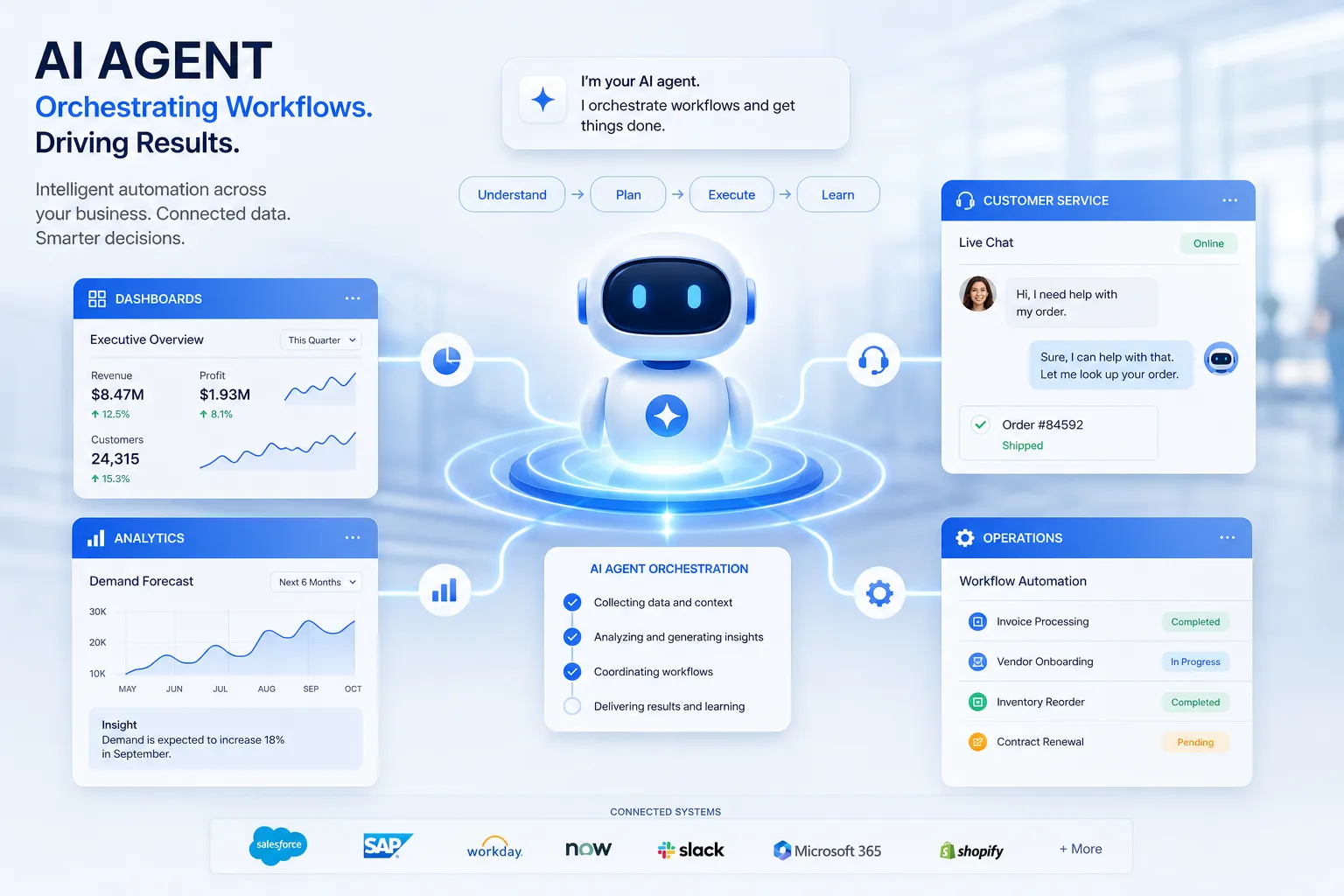
An AI agent is a software system that can pursue a goal with a degree of autonomy. Instead of only responding to a single prompt, it can interpret context, use memory, access tools or connected systems, make decisions, and complete tasks across multiple steps.
That makes it fundamentally different from older automation models:
System | What it does | Limitation |
|---|---|---|
Traditional software automation | Follows fixed rules | Breaks when conditions change |
Chatbot or basic assistant | Responds to prompts | Usually stops at answers, not actions |
AI agent | Observes, plans, acts, and adapts | Requires governance, integration, and oversight |
For a business leader, the simplest definition is this: an AI agent is a digital operator that can help move work forward, not just talk about it.
How an AI Agent Works
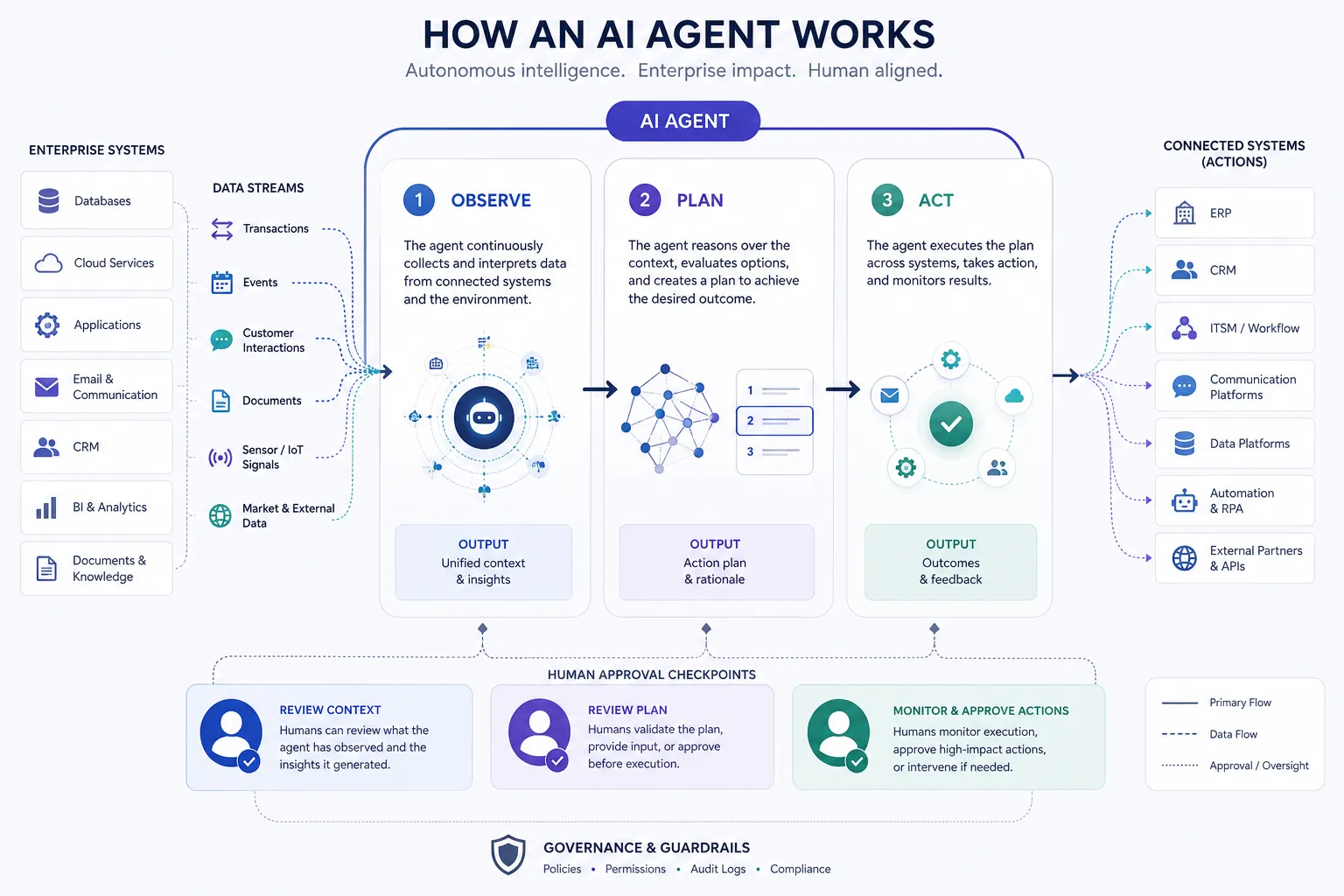
Most AI agents follow a simple but powerful operating loop: observe, plan, and act.
Observe
The agent gathers inputs from its environment. That may include:
customer messages
CRM records
store activity
production data
support tickets
performance dashboards
uploaded images or assets
Plan
Using AI models, business rules, memory, and goals, the agent determines the best next step. It can prioritize options, ask for clarification, or decide whether to escalate to a human.
Act
The agent then uses connected systems to execute tasks. That could mean:
generating a report
updating an order
responding to a customer
creating a product layout
routing a job to production
triggering approval workflows
launching fulfillment steps
Why this matters in real business operations
Competitor articles often explain the concept well, but they usually stop at general examples like customer service or coding. The bigger opportunity is workflow orchestration. The real business value appears when an AI agent connects previously fragmented steps into a continuous flow.
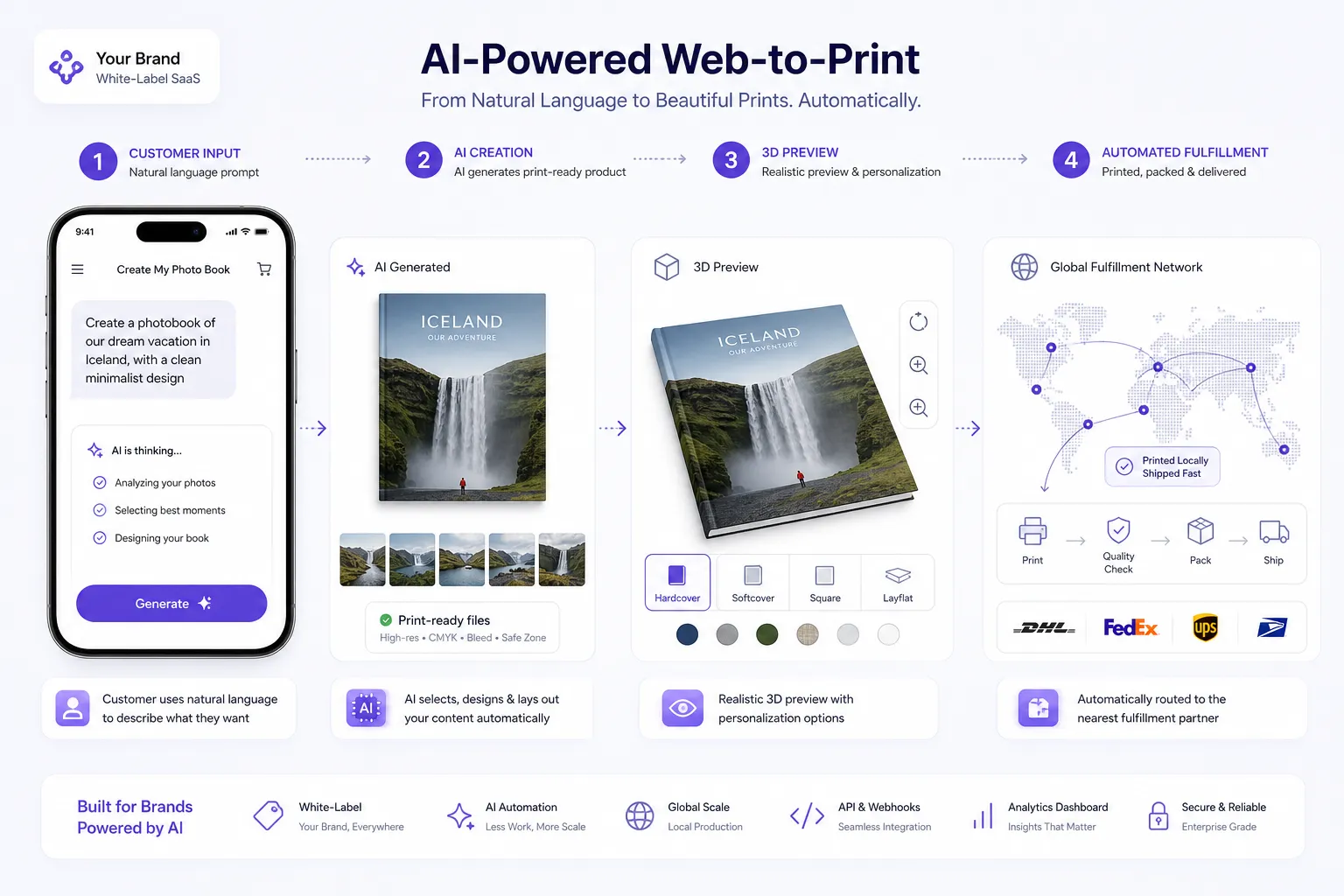
For example, instead of asking a customer to learn a complicated design interface, an AI-powered print platform can let them describe what they want in plain language. The agent can then convert that prompt into a print-ready concept, place photos intelligently, generate layouts, render photorealistic previews, and prepare the order for on-demand production.
That is not just assistance. That is end-to-end commercial acceleration.
What an AI Agent Actually Does for Modern Businesses
An AI agent creates value by reducing friction between intent and execution. Here are the most important ways businesses use them today.
1. Automates repetitive operational work
Agents remove manual effort from repetitive but necessary tasks such as data gathering, routing, validation, tagging, scheduling, and status updates.
This helps teams spend less time on admin and more time on exception handling, quality control, strategy, and customer relationships.
2. Improves decision speed
Because agents can pull data from multiple sources instantly, they help teams make faster and more informed decisions. Instead of waiting for a report or manual review, leaders can get contextual recommendations in real time.
3. Personalizes customer experiences at scale
AI agents can tailor responses, product suggestions, layouts, and journeys to the individual user. In e-commerce and print, that directly improves conversion rates because the customer gets faster relevance with less effort.
4. Handles multi-step workflows
The most valuable agents do not stop after one action. They can complete entire flows that move across systems, such as intake, validation, design, approval, payment, and production.
5. Extends team capacity without linear hiring
Growth usually means more customer requests, more SKUs, more support load, and more production complexity. AI agents let businesses scale output without expanding headcount at the same rate.
6. Creates more resilient operations
Agents can work around the clock, monitor for failures, flag anomalies, and maintain consistency in execution. That is especially valuable in businesses with seasonal spikes or globally distributed fulfillment.
The Business Case for AI Agents
Organizations are adopting AI agents because the economics are compelling. When deployed well, they can lower the cost of service delivery, shorten cycle times, improve customer satisfaction, and increase revenue per employee.
Key benefits
Benefit | Business impact |
|---|---|
Faster response times | Better customer experience and lower abandonment |
Lower manual workload | Reduced overhead and fewer operational bottlenecks |
Better consistency | Fewer errors and more reliable outputs |
Higher scalability | Growth without proportional labor expansion |
Better use of business data | Smarter decisions and stronger forecasting |
24/7 availability | Always-on support and workflow execution |
Why adoption is accelerating now
Three things have changed:
AI models are more capable, especially in language, reasoning, and multimodal tasks.
Enterprise integrations are improving, making it easier for agents to connect to real systems.
Businesses now need efficiency gains urgently, not eventually.
For print and product personalization businesses, there is also a fourth reason: legacy creation journeys are too slow for modern buyers. If a user has to learn a complicated editor before seeing value, conversion suffers. An AI agent closes that gap.
Types of AI Agents Businesses Should Know
Not every AI agent is equally advanced. Understanding the spectrum helps you choose the right model for the right workflow.
Simple reflex agents
These follow predefined rules. They are useful for narrow, predictable tasks but cannot adapt much when inputs change.
Model-based agents
These keep an internal view of the environment and can make better decisions based on context.
Goal-based agents
These work toward specific outcomes and can evaluate different paths to achieve them.
Utility-based agents
These optimize for the best result based on multiple variables, such as speed, cost, quality, or customer value.
Learning agents
These improve over time based on feedback, outcomes, and new data.
Single-agent systems
One agent manages one workflow or domain.
Multi-agent systems
Multiple agents specialize and collaborate. One might gather information, another generate content, another validate assets, and another trigger fulfillment.
For businesses moving into AI-powered commerce, multi-agent models are especially promising because they mirror how real operations work across teams and systems.
How AI Agents Are Being Used Across Industries
Competitor content commonly mentions broad sectors like finance, healthcare, and retail. That is useful, but businesses need practical translation. Here is how the pattern shows up in different environments.
Customer service
Agents resolve common issues, triage incoming requests, pull account context, and escalate only when human judgment is needed.
Sales and marketing
Agents analyze campaign performance, recommend optimizations, produce content variants, qualify leads, and automate follow-up sequences.
Operations
Agents reconcile records, monitor exceptions, route tasks, track SLAs, and surface bottlenecks.
Technology teams
Agents support code generation, testing, documentation, incident summaries, and modernization projects.
Finance and compliance
Agents assist with fraud detection, policy checks, audit trails, approval routing, and risk flagging.
Product personalization and print
This is one of the most commercially exciting use cases because AI agents can compress an entire creation workflow.
They can:
interpret natural-language requests
suggest product formats
organize uploaded images
generate layouts automatically
produce print-ready outputs
show 3D and AR previews
trigger on-demand production
coordinate fulfillment
That is where Media Rex Alliance fits naturally into the future of AI-powered web-to-print.
AI Agents in Web-to-Print: The Missing Opportunity Most Articles Ignore
Most articles about AI agents talk about banking, support, or software development. Few explain how transformative they are for physical product creation, especially in print, photo products, and on-demand manufacturing.
This is a major content gap, and it matters.
Traditional web-to-print experiences often fail because they ask too much of the buyer:
learn the editor
understand layout tools
place images manually
review every detail
troubleshoot on mobile
repeat the same work across devices
That friction hurts conversion and increases abandonment.
What an AI agent changes in the print journey
An AI agent can turn the user flow into something far more intuitive:
Traditional flow | AI-agent-powered flow |
|---|---|
User opens complex editor | User enters a conversational prompt |
User designs manually | Agent generates structure and layout |
User struggles on mobile | Mobile-first browser experience reduces friction |
User cannot visualize final product clearly | Photorealistic 3D and AR previews build confidence |
Business manages fragmented production steps | Automated fulfillment routes jobs to global print partners |
Why this matters commercially
For studios, photographers, and print brands, an AI-agent-led experience can improve both acquisition and fulfillment economics:
higher conversion from easier product creation
faster time to purchase
lower support burden
reduced design abandonment
on-demand production with less inventory risk
scalable white-label deployment across multiple storefronts
How Media Rex Alliance Applies AI Agents to Real Business Growth
Media Rex Alliance is not just another AI interface layered on top of print. It is a white-label AI print platform built for businesses that want to modernize product creation without building the entire stack from scratch.
Conversational creation instead of design-tool overload
Customers can create products through natural language rather than complex editors. That means less training, less friction, and a faster path from idea to order.
Prompt-to-product speed
The platform turns prompts into print-ready products quickly, which reduces hesitation and speeds up purchase decisions. In a category where every extra step can cost a sale, that speed matters.
White-label deployment
Media Rex Alliance integrates into existing storefronts or apps and can be fully branded to match the client’s domain, design system, and visual identity. Businesses keep the customer relationship while upgrading the technology behind it.
Photorealistic 3D and AR previews
Confidence drives conversion. By letting customers preview products in realistic 3D and immersive AR before buying, the platform helps reduce uncertainty and improve order confidence.
Mobile-first, browser-based experience
No app installation required. That lowers acquisition friction and supports modern buyer behavior, especially for mobile-heavy audiences.
Cross-device continuity
Projects sync locally and in the cloud, so users can start on one device and continue on another without losing progress.
On-demand production economics
By supporting a no-stock model, businesses can reduce inventory exposure and overhead while still offering premium products.
Automated global fulfillment
The platform connects to a network of high-end printers, allowing businesses to scale delivery and production quality without building a global manufacturing infrastructure themselves.
For startups, mid-size brands, and enterprise print businesses alike, this is a practical way to deploy AI-agent-led product creation at scale.
The Core Components of an Effective AI Agent Strategy
If you want business value, you need more than a model. You need an operating system around it.
1. Clear business objective
Start with a measurable outcome:
reduce support tickets
improve product creation completion rate
shorten order cycle time
increase conversion on mobile
reduce manual production setup
2. Access to quality data
AI agents are only as good as the context they can use. Clean data, connected systems, and structured assets matter.
3. Tool and system integration
The agent must be able to act, not just analyze. That means APIs, workflow connections, permissions, and orchestration layers are essential.
4. Human-in-the-loop controls
Not every workflow should be fully autonomous. Critical decisions may require review, approval, or intervention.
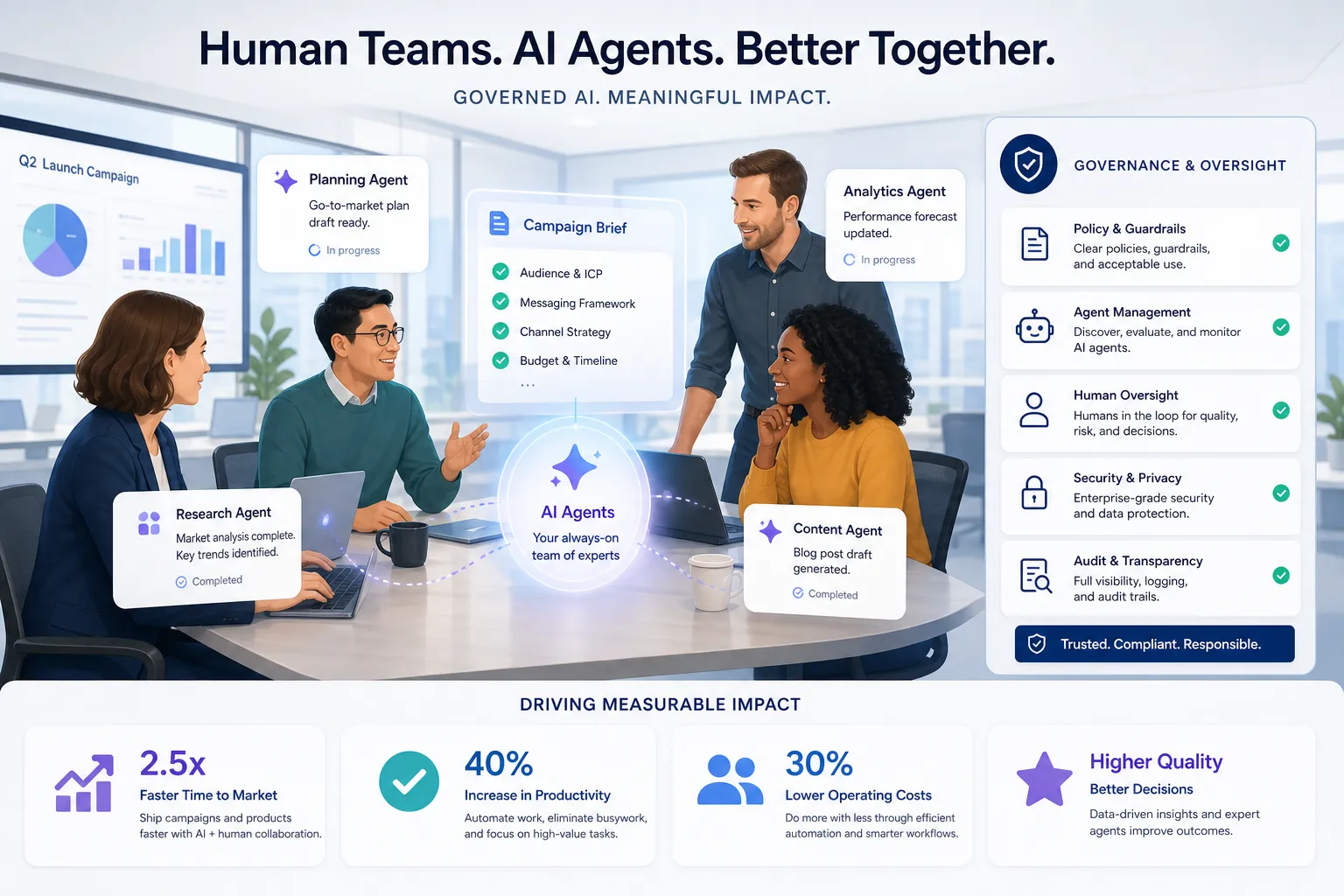
5. Governance and monitoring
You need visibility into outputs, edge cases, errors, and compliance exposure. Monitoring is not optional.
6. Feedback loops
The best AI agent systems improve over time. Use customer behavior, team corrections, and operational outcomes to refine the system continuously.
Challenges Businesses Must Solve Before Scaling AI Agents
Competitor articles rightly mention compliance, privacy, and integration. But they often understate the operational reality: deploying agents at scale is not mainly a prompt-writing challenge. It is a systems challenge.
Data quality
Fragmented, outdated, or inconsistent data weakens decision-making and output quality.
Workflow integration
An AI agent that cannot reach the systems where work happens will never create real value.
Trust and accountability
Businesses need to know when the agent should act, when it should ask, and when it should stop.
Security and permissions
The more power an agent has, the more important role-based access and auditability become.
Edge cases and exceptions
Agents are strong on repeatable workflows but still need escalation paths for ambiguous or high-risk cases.
Change management
Teams need training, clarity, and confidence. AI agents work best when employees see them as force multipliers, not black-box threats.
A Practical Framework for Choosing Where to Deploy an AI Agent First
Not every process is the right first use case. The best starting points usually share five traits:
Good first use case trait | Why it matters |
|---|---|
High volume | More automation upside |
Repeatable workflow | Easier to standardize |
Clear success metrics | Faster ROI measurement |
Moderate complexity | Valuable, but not too risky |
Connected data and systems | Easier implementation |
Strong starting points for print and personalization businesses
product creation flows with high abandonment
support journeys with repetitive questions
prepress validation steps
quote and configuration workflows
order routing and fulfillment orchestration
upsell recommendations based on user intent
What the Future Looks Like
The future of AI agents is not just smarter chat. It is operational autonomy combined with human oversight.
Businesses will increasingly use agents to:
run workflows across departments
personalize product experiences instantly
connect customer intent directly to production
reduce dependence on manual coordination
launch new services faster with less infrastructure
In print and photo commerce, the biggest shift will be from tool-driven creation to intent-driven creation. Customers will stop learning how to design and start describing what they want. The platform will do the rest.
That shift favors businesses that can launch branded, scalable, low-friction experiences quickly. Media Rex Alliance is built precisely for that transition.
Final Verdict: Why Modern Businesses Are Betting on AI Agents
An AI agent gives modern businesses a new operating layer between customer intent and business execution. It can reduce friction, automate work, improve decisions, and unlock scale in ways that legacy tools cannot match.
For print businesses, studios, photographers, photo book brands, and on-demand product companies, the opportunity is even bigger. AI agents do not just optimize back-office tasks. They can reinvent how products are created, previewed, approved, and fulfilled.
Media Rex Alliance brings that future into a deployable, white-label SaaS model. Instead of spending years building custom AI-powered web-to-print infrastructure, businesses can launch a branded experience that converts conversational prompts into premium physical products, supports mobile-first creation, delivers photorealistic previews, and automates fulfillment through a global network.
If your business wants to reduce friction, improve conversions, modernize product creation, and scale without rebuilding everything from scratch, Media Rex Alliance is the smarter path forward.
FAQ
What can an AI agent do for my business?
An AI agent can automate multistep work, improve response times, analyze data, personalize customer experiences, and trigger actions across your systems. For product-based businesses, it can also reduce friction in creation, ordering, and fulfillment workflows.
What is a $900000 AI job?
This usually refers to high-end AI leadership or specialist roles at major tech firms, such as elite research, infrastructure, or product positions tied to advanced AI systems. It is not a standard benchmark for most businesses adopting AI agents.
What is the 30% rule for AI?
The phrase can mean different things depending on the context, but it often describes a target for time savings or workflow automation through AI. In practice, businesses should focus less on slogans and more on measurable gains in speed, cost, quality, and conversion.
What is the main purpose of AI agents?
The main purpose of AI agents is to observe, decide, and act toward a business goal with limited human intervention. They help organizations turn data and intent into completed actions faster and more efficiently.
What are the 7 types of AI agents?
A practical business view includes simple reflex, model-based, goal-based, utility-based, learning, single-agent, and multi-agent systems. These categories range from rule-following automation to collaborative agents that manage complex workflows.
What is the 30% rule for AI?
There is no single universal definition, but many teams use it informally to describe a meaningful productivity threshold that justifies adoption. The better approach is to evaluate AI agents against concrete KPIs such as reduced manual effort, faster turnaround, and higher conversion.