
White Label Print on Demand for Scalable Growth
Scaling a modern print business is no longer about buying more equipment, holding more stock, or forcing customers through outdated design workflows. For small studios, photographers, new print-on-demand brands, regional print companies, and established photo product businesses, the real growth lever is speed, flexibility, and customer experience.
That is why white label print on demand has become such a powerful model. It allows brands to launch custom product lines under their own identity while outsourcing production and fulfillment to specialized partners. The result is lower overhead, faster go-to-market execution, and a far more agile way to test, sell, and expand.
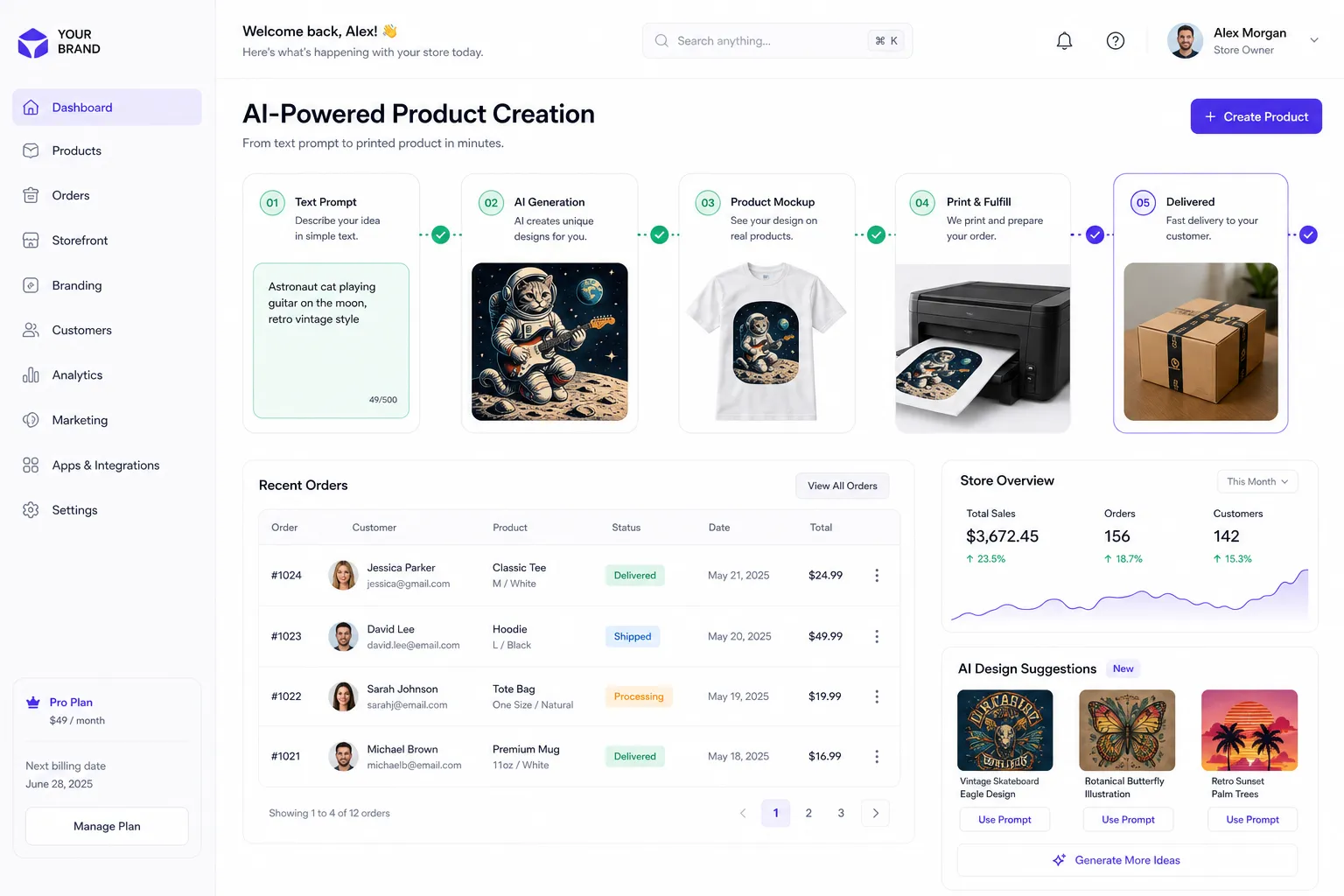
But the next evolution is even more important: combining white-label fulfillment with AI-powered product creation. Instead of making buyers struggle through complex editors, Media Rex Alliance enables businesses to let customers create products through conversational prompts, generate print-ready layouts automatically, and review purchases with photorealistic 3D and AR previews before ordering. That shift reduces friction dramatically and turns product creation into a conversion engine.
"The global print-on-demand market was valued at USD 10.8 billion in 2025 and is projected to reach USD 57.5 billion by 2033, growing at a CAGR of 23.6% from 2026 to 2033." - Grand View Research
What white label print on demand really means
At its core, white label print on demand is a business model where products are produced only after a customer places an order, but they are sold under your brand rather than the manufacturer’s.
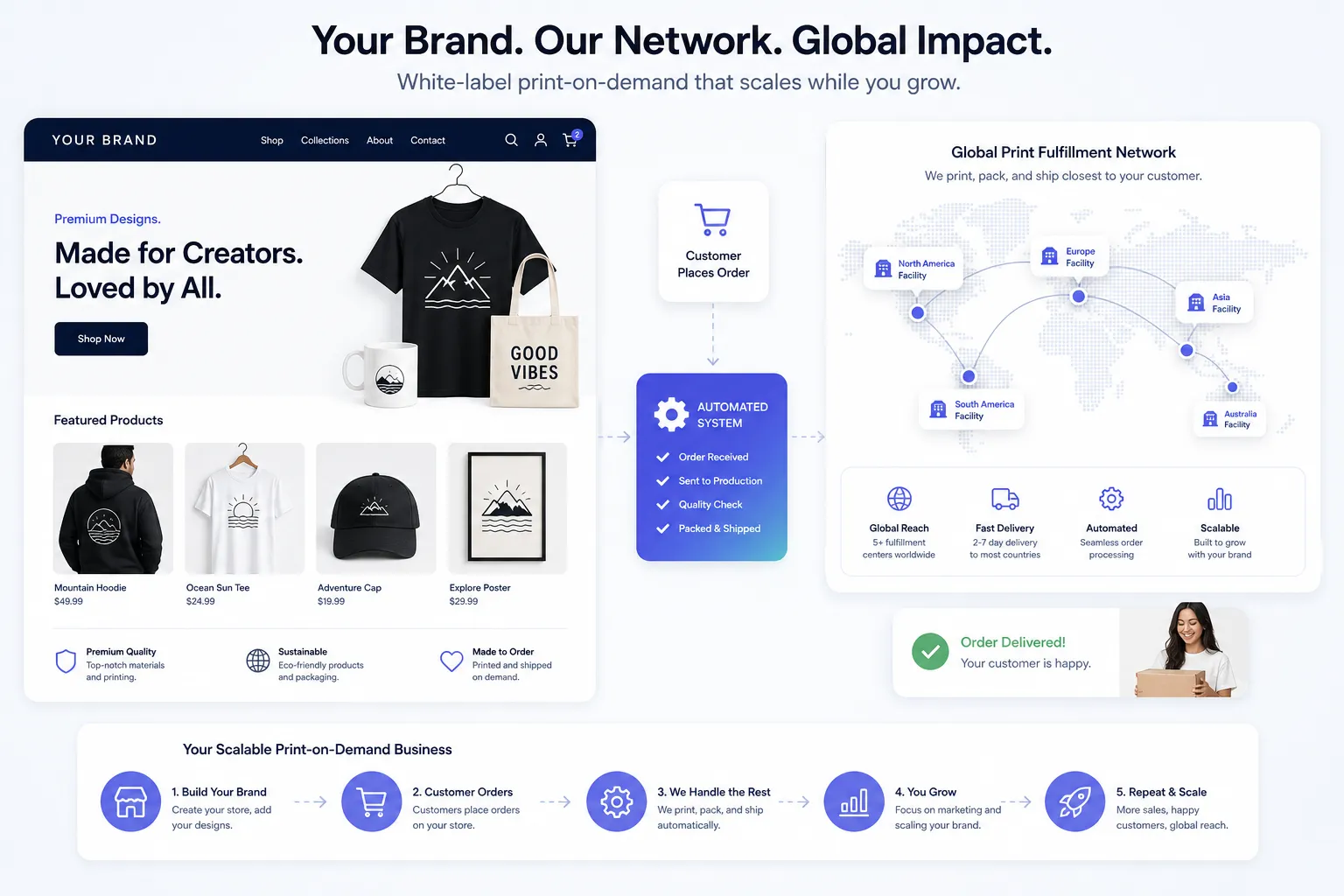
That means your customer interacts with your storefront, your branding, and your product experience. Behind the scenes, production and shipping are handled by a print partner or distributed production network.
This model matters because it separates brand growth from manufacturing complexity. You can focus on customer acquisition, merchandising, pricing, positioning, and retention while the fulfillment layer runs in the background.
The three layers of the model
Layer | What the customer sees | What your business controls |
|---|---|---|
Brand layer | Your site, products, packaging feel, visual identity | Messaging, pricing, merchandising, positioning |
Creation layer | Product customization experience | Design flow, personalization logic, approvals |
Fulfillment layer | Delivery of finished goods | Supplier network, routing, production standards, shipping speed |
Most competitors explain the branding side and the fulfillment side. What they often miss is the creation layer, which is where many conversions are won or lost.
If product personalization is hard, slow, or confusing, shoppers abandon. If it is intuitive and fast, average order value and conversion potential rise. This is where Media Rex Alliance creates a strategic advantage.
Why businesses choose this model to grow
The appeal of white-label production is obvious, but the real reason businesses adopt it is operational leverage. Growth becomes less dependent on inventory and more dependent on demand generation.
Lower capital risk
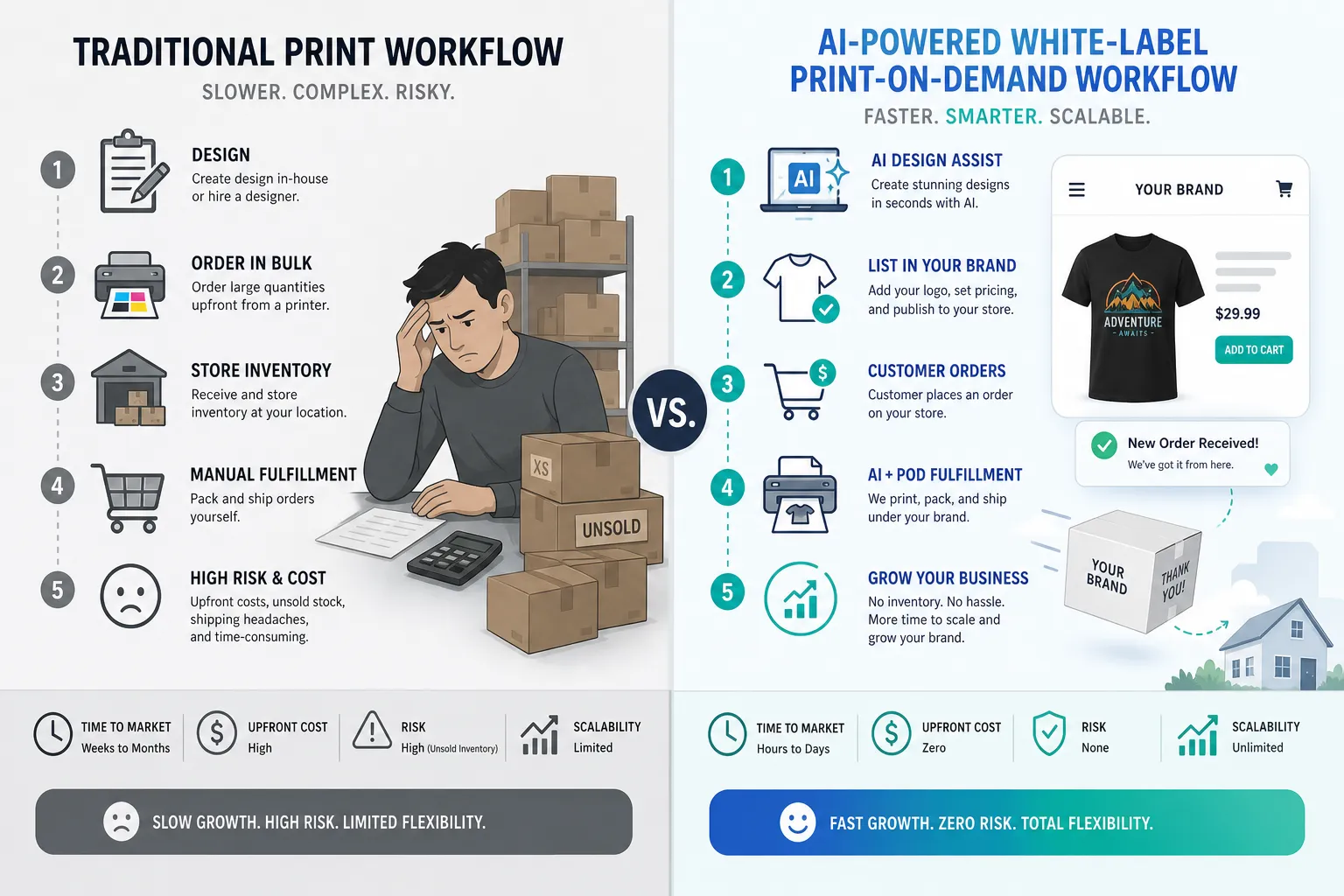
Traditional print expansion usually requires upfront stock commitments, warehousing, and production planning. On-demand production flips that model. You sell first, produce second.
This reduces:
Inventory exposure
Overstock risk
Dead stock tied to trends or seasonal demand
Cash flow pressure during launches
Faster experimentation
Brands can test new categories, design concepts, and market segments without locking money into bulk runs. A local photo studio can launch framed prints, books, and gifts. A niche apparel brand can test fresh artwork weekly. A regional print player can pilot personalized products before a wider rollout.
Easier operational scaling
As orders increase, a good white-label system scales through automation instead of headcount. The best platforms reduce manual intervention across:
Product creation
Proof generation
Order routing
Print file preparation
Fulfillment tracking
Stronger brand ownership than classic dropshipping
Traditional dropshipping often leaves the retailer with limited product uniqueness and weak brand differentiation. White-label print on demand creates a stronger moat because the product experience can be personalized, branded, and tailored to your audience.
White label vs private label vs traditional print fulfillment
A lot of articles blur these business models together. That creates confusion when businesses are deciding what kind of growth infrastructure they actually need.
Model | Product uniqueness | Inventory required | Brand control | Setup complexity | Speed to launch |
|---|---|---|---|---|---|
White label print on demand | Moderate to high | No | High | Low to medium | Fast |
Private label | High | Usually yes | Very high | High | Slower |
Traditional in-house print | High | Often yes | Very high | High | Medium to slow |
Generic dropshipping | Low | No | Low to medium | Low | Fast |
For most digital print businesses and modern commerce brands, white label print on demand offers the best balance of speed, control, and scalability.
The hidden bottleneck competitors gloss over: the customer creation experience
Many competitor articles focus on product range, supplier reliability, and low startup costs. All of that matters. But they underplay the single biggest friction point in custom commerce: making it easy for customers to create something worth buying.
This is where many print businesses lose revenue.
Complex editors create problems:
Too many steps before checkout
Poor mobile usability
Slow rendering
Low confidence in final output
Design abandonment before purchase
Media Rex Alliance solves this by replacing clunky creation tools with conversational AI. Customers can describe what they want in natural language, upload photos if needed, and let the platform generate a ready-to-print product automatically.
That changes the buying journey from “design work” into “guided creation.”
How Media Rex Alliance modernizes white-label print commerce
Media Rex Alliance is designed for businesses that want more than basic fulfillment. It gives print companies and product brands an AI-powered web-to-print layer they can launch under their own identity.
Conversational product creation
Instead of forcing customers into traditional design software, the platform allows them to create products through prompts. This is especially valuable for users who are not designers but still want a personalized result.
A customer might describe a travel photo book, a branded merchandise concept, or a custom wall art layout. The engine translates that intent into a print-ready product quickly.
Faster path from idea to checkout
By turning prompts into layouts automatically, the platform reduces creation time and decision fatigue. That means fewer abandoned sessions and more completed purchases.
Fully white-label deployment
Media Rex Alliance can be integrated into an existing storefront or app with your branding, domain, and visual identity. The experience feels native to your brand, not borrowed from a third-party platform.
Photorealistic 3D and AR previews
One of the strongest conversion drivers in custom commerce is confidence. If shoppers cannot visualize what they are buying, they hesitate.
Media Rex Alliance addresses that with photorealistic 3D previews and immersive AR product visualization, helping customers feel more certain before they place an order.

Mobile-first, browser-based access
Many legacy design flows still perform poorly on mobile. Media Rex Alliance is built for browser-based, no-install usage, which is critical for today’s purchase behavior. Customers can create and order from any device without downloading an app.
Cloud and local sync across devices
Multi-session purchasing is increasingly common. Buyers may start on mobile, continue on tablet, and complete on desktop. Seamless local and cloud sync makes that journey practical instead of frustrating.
Automated fulfillment through a global premium printer network
The platform is built around an on-demand model that reduces inventory and overhead while automating fulfillment through a global network of high-end print partners. Businesses can scale geographic reach without building distributed production infrastructure themselves.
The end-to-end workflow of a scalable white-label setup
A modern system should do much more than print orders. It should connect product creation, commerce, and fulfillment into one streamlined pipeline.
1. A customer enters intent
The shopper begins with a prompt, an uploaded photo, or both. This can happen inside your own branded store or integrated web app.
2. AI generates the product layout
Instead of requiring manual assembly, the system produces a polished, print-ready concept based on the customer’s request.
3. The customer reviews in 3D or AR
Preview technology reduces uncertainty and gives a better sense of product realism, fit, and finish.
4. The order is confirmed
Once purchased, order details and production assets move automatically into the fulfillment pipeline.
5. A global print network produces on demand
The job is routed to appropriate production capacity, reducing lead times and avoiding stock commitments.
6. The product ships under your brand experience
The customer experiences your business as the source of the purchase, while operations remain largely automated.
Where white-label growth creates the biggest opportunity
Not every business uses this model in the same way. The strongest strategies depend on the type of company and customer base.
Small studios and photographers
These businesses often have strong creative credibility but limited operational scale. White-label infrastructure allows them to expand from services into products without building logistics capacity.
Ideal categories include:
Photo books
Fine art prints
Framed wall art
Gift products
Personalized keepsakes
New print-on-demand brands
For startups, the model provides speed. They can launch niche concepts, test creative directions, and validate product-market fit without being buried in production complexity.
Mid-size and regional print brands
These businesses usually already have customers, local awareness, and category knowledge. Their challenge is modernization. An AI-powered white-label platform helps them upgrade the buying experience without rebuilding everything from scratch.
Established photo product companies
Legacy photo book and personalized product brands often have demand but outdated creation interfaces. Replacing or extending those flows with conversational AI can materially improve conversion and reduce abandonment.
Enterprise print companies
Larger businesses need more than product creation. They need brand control, scalability, integration flexibility, and automated throughput. A white-label SaaS architecture helps them launch branded experiences across markets without fragmenting the stack.
The economics of smarter scaling
One of the strongest reasons to adopt this model is margin protection through efficiency. While per-unit production costs may be higher than large-scale bulk manufacturing, the overall business can become more profitable because it avoids waste and reduces overhead.
Traditional bulk model vs on-demand model
Cost factor | Traditional bulk production | White-label on-demand model |
|---|---|---|
Inventory investment | High | Minimal |
Warehousing | Required | Limited or none |
Obsolescence risk | High | Low |
Time to launch | Slower | Faster |
Product testing cost | Expensive | Low |
Cash flow flexibility | Lower | Higher |
SKU expansion | Harder | Easier |
The real gain is not just in cost reduction. It is in strategic flexibility.
Customer confidence is now a growth metric
Competitor content often discusses quality control, but fewer articles connect quality perception to conversion behavior.
That connection matters.
When customers buy a personalized product, they need confidence in:
Print quality
Layout quality
Product realism
Brand trust
Delivery reliability
"The market is expected to reach USD 54.73 billion by 2032, driven by rising demand for personalized products." - SNS Insider via GlobeNewswire
This is why 3D previews, AR experiences, and strong product rendering are not cosmetic features. They are trust technologies. They reduce hesitation and make premium pricing easier to support.
Common mistakes brands make with white-label print strategies
The model is powerful, but many businesses still underperform because they treat it as a commodity play.
Mistake 1: Competing only on product count
A giant catalog is not a strategy. Too many products can dilute focus and confuse shoppers. Curated assortments aligned to audience intent usually convert better.
Mistake 2: Ignoring mobile design friction
If product customization is painful on a phone, a major share of potential revenue disappears. Mobile-first design is no longer optional.
Mistake 3: Treating fulfillment as the only differentiator
Fast production matters, but so does the buying journey. If your creation flow feels old, your brand feels old.
Mistake 4: Using generic third-party branding
If the user experience visibly belongs to another platform, brand equity leaks away. Fully white-label deployment preserves ownership of the customer relationship.
Mistake 5: Failing to modernize proofing and previews
Static mockups are often not enough for premium custom products. Rich previews improve confidence and reduce support load.
What to evaluate before choosing a white-label print platform
If scalable growth is the goal, businesses should assess more than catalog size.
Core evaluation criteria
Capability | Why it matters |
|---|---|
White-label integration | Keeps brand ownership intact |
AI-assisted creation | Reduces friction and expands accessibility |
Mobile-first UX | Supports modern buyer behavior |
3D/AR previews | Increases confidence and conversions |
Print-ready automation | Reduces manual production prep |
Global fulfillment network | Improves reach and resilience |
Multi-device sync | Supports longer customer journeys |
No-inventory model | Preserves cash flow and flexibility |
Most providers can help you sell products. Far fewer can help you sell them with less friction, better confidence, and more scalable customer experience.
The future of white-label print is not just fulfillment, it is intelligent commerce
The market is moving beyond simple print-on-demand execution. The next generation of winning businesses will combine:
AI-assisted product creation
branded white-label storefront experiences
immersive previews
automated fulfillment
agile on-demand economics
That combination is especially important in industries where personalization drives emotional purchases, such as photo products, gifting, creator merchandise, branded goods, and premium printed keepsakes.
Why Media Rex Alliance is built for the next stage of growth
Media Rex Alliance is not just another print tool. It is a white-label AI print platform built for businesses that want to modernize how customers create, preview, and order premium physical products.
It is especially effective for:
photo book companies updating legacy web-to-print flows
studios and photographers expanding product revenue
new brands launching without inventory burden
regional print businesses modernizing customer experience
enterprise print companies deploying branded creation technology at scale
By combining conversational AI, browser-based creation, photorealistic previews, seamless cross-device workflows, and automated on-demand fulfillment, the platform helps businesses grow without inheriting the traditional costs and complexity of scale.
Final verdict
White label print on demand is one of the smartest growth models in modern print commerce because it reduces inventory risk, shortens launch cycles, and creates room for rapid experimentation. But the real winners will be the businesses that go beyond basic fulfillment and invest in a better creation experience.
That is the gap many providers still leave open.
Media Rex Alliance closes it with a future-ready SaaS platform that turns prompts into print-ready products, wraps the entire experience in your brand, and supports scalable fulfillment through a global network of premium printers. If your business wants to reduce friction, improve conversion, and launch a more intelligent web-to-print experience without building the stack from scratch, this is the direction to take.
For print businesses that want scalable growth with stronger customer experience, Media Rex Alliance offers the fastest path from idea to premium product.